
Choosing an A&A Contractor for a Landed House: The Checks to Make Before You Sign
Most owners compare A&A contractors on the number at the bottom of the quotation, then on how they felt about the person who came to see the house. Both matter. Neither tells you whether the company can legally take on the job, who will actually be responsible for the structure, or what happens when something goes wrong halfway through.
On our jobs, a focused landed A&A typically takes six to twelve months from first meeting to handover, and a full reconstruction twelve to eighteen. That is a long time to be tied to a decision made on price and a good first impression. The checks below take a few evenings. Most of them can be done before you have paid anyone anything.
1. Is the work renovation, or building work?
Start with your own project, not the contractor. If it changes the structure of the house or adds floor area, it is building work. Removing a load-bearing wall, adding a storey, extending out, cutting into a slab or underpinning a foundation all fall into that category. New finishes, carpentry, flooring and a new kitchen on the existing layout do not.
That line decides who you can hire. A storey addition or a structural alteration needs a contractor holding a BCA General Builder licence. A renovation contractor cannot legally take it on, however capable the crew is. We explain where the line falls, and what happens when a project quietly crosses it, in when your project stops being A&A and becomes a reconstruction.
2. Look the company up yourself
Do not rely on a logo on a name card or a line on a website. BCA keeps a public directory of licensed builders, and it takes a couple of minutes to search.
- The company name and UEN. The entity on the register should be the same entity that signs your contract and issues your invoices. A different company on the quotation is a question worth asking before you sign, not after.
- The licence and its class. A General Builder Class 1 can take on projects of any value. A Class 2 is restricted to projects valued at $6 million or less, which covers landed A&A work. The class matters less than the fact that the licence exists and is current.
- Validity. Check that the licence runs through the period your works will take.
For what the licence does and does not cover, see what GB2 means for a landed home build. For the record, Wong Lye Pte Ltd, UEN 201404127Z, holds a BCA General Builder Class 2 (GB2) licence and is bizSAFE Level 3.
3. Find out who is responsible for the design and the submissions
The URA and BCA submissions for structural work are made by a QP, a Qualified Person, which means the architect or the professional engineer. Not by the builder. The structural engineer's design is what the builder builds to, and under BCA's rules it is the QP who appoints the site supervision for the structural works when the permit is applied for.
So the useful question is not "do you handle the approvals?" Almost everyone will say yes. Ask instead:
- Who is the architect and who is the structural engineer on my job, by name?
- Are they inside your quotation, or do I appoint and pay them separately?
- If the engineer's design and the builder's price disagree, who resolves it, and who pays for the difference?
When the drawings, the submissions and the build sit with three separate companies, the owner is the one left coordinating them. Our own approach is to coordinate the architect and the structural engineer as part of one quotation, so there is one accountable party. Either model can work. What matters is that you know which one you are signing up for. More on the role in what a QP actually does for your landed A&A project.
4. Ask what they checked before they quoted
A quotation produced the same afternoon as the site visit is a quotation produced without the checks that decide the price. Before we put a number on paper, we walk the property, pull the plot's URA records for zoning, plot ratio and setbacks, and look at whether the existing foundation and structure can carry what the owner wants to add. For homes built before 1990 we always do a foundation review and a column and beam load calculation before quoting.
You do not need a builder to work exactly this way. You do need a builder who can tell you what they checked, and what they assumed about what they could not check. A quotation that has not looked at the existing structure has priced a house that may not exist.
5. Read the quotation for what it leaves out
Three quotations from the same drawings can be far apart for reasons that have nothing to do with honesty: different exclusions, different allowances, different assumptions about the site. We go through where those gaps hide in why two builders quote very different prices from the same drawings, and how allowances behave in provisional sums and PC sums.
Before choosing, ask every contractor for:
- a line-itemised breakdown, not a lump sum;
- a written list of exclusions;
- how variations will be priced and approved once work starts, which we cover in variation orders on a landed build;
- how discoveries in the existing structure are handled and priced once it is opened up.
6. Look at how you are asked to pay
The payment schedule tells you how much risk you are carrying. If a large share of the contract sum is paid before much has been built, you are funding the job ahead of the work. If the builder then stalls or walks away, that money is in the house only on paper. Taking over a stalled A&A project describes what that looks like from the other side.
Our own structure is a small deposit, typically 5 to 10 percent of project value, with the rest billed at milestones tied to work that has actually been completed and verified. If at any point during the build the client is unhappy, they can stop the project and pay only for work that has been done. Whoever you appoint, ask what each payment is tied to, and what happens to money already paid if the project stops. See progressive milestone billing.
7. Ask to see work in progress, not only finished photos
Finished photos show finishes. They do not show the part of an A&A that decides whether the house is sound in ten years: the propping, the reinforcement before a pour, the waterproofing before it is tiled over, how the site is kept.
Ask any contractor you are considering whether you can see one of their current sites, or dated photos of work at the structural stage. We publish ours as the work happens, with dates, on Live Jobs, and clients are welcome to visit their own site at any time during construction. Things to notice on any live site: whether openings and edges are barricaded, whether temporary propping is in place where structure has been removed, whether materials are stored off the ground and protected, and whether someone on site can tell you what stage the job is at and what comes next.
8. Get the warranty and insurance in writing, per item
"We give warranty" is not a warranty. Before you sign, get in writing how long it runs and from when, the period for each item, what is excluded, and whether it passes to a buyer if you sell. Twelve months is common in the trade.
On a landed home, everything we build carries seven years from handover, with the period written beside every item in the quotation. Exterior wall painting is five years, in line with Nippon's own product warranty. The warranty follows the house. It does not cover existing structure we did not touch, or the joint where a new extension meets the existing house. Our public liability insurance is in force for the whole of the project. The full terms are on our A&A works page, and how to use a warranty after handover is in your warranty after handover on a landed home.
Questions to put to every contractor on your shortlist
- What is the exact company name and UEN on your BCA licence, and is that the company that will sign my contract?
- Who are the architect and structural engineer on my job, and are they inside your quotation?
- What did you check about my plot and the existing structure before quoting, and what did you assume?
- Can I have the breakdown, the exclusions list and your method for pricing variations in writing?
- What is each payment tied to, and what happens to money paid if the job stops?
- Can I see a site of yours at the structural stage, or dated photos of one?
- What is the warranty on each item, from when, and what is excluded?
- How long do you expect the submissions to take before physical work starts, and the works after that?
A good contractor answers these plainly and in writing, and does not mind being asked. How someone responds to being checked is usually a fair preview of how they will respond to a problem on site.
The short version
- If the work is structural or adds floor area, the contractor needs a BCA General Builder licence. Check it on BCA's public directory yourself.
- Find out who the QP and structural engineer are, and whether they are inside the quotation.
- Compare exclusions, variation terms and the payment schedule, not only the total.
- Look at work in progress, and get the warranty in writing, per item.
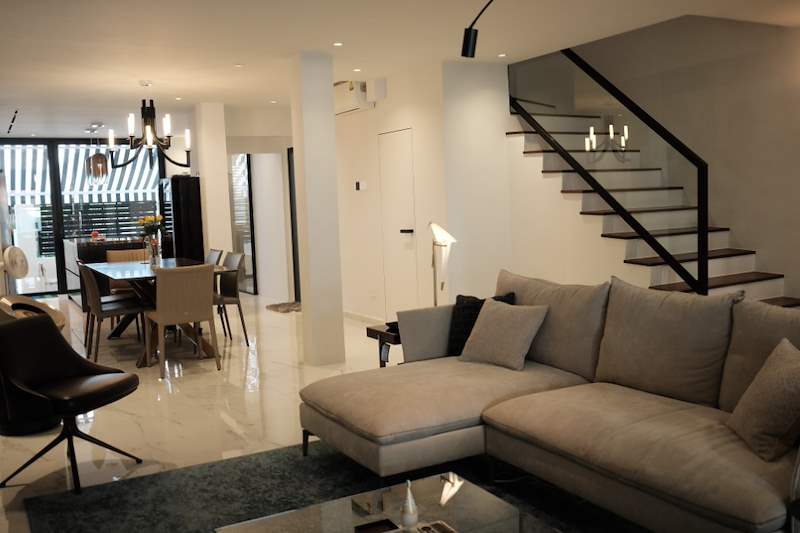
The photo above is the finished open-plan living and dining area of one of our landed terrace A&A projects, with the new black-framed staircase beyond. What it looked like before and during the works is in our project photos.
If you are comparing contractors for A&A works on a landed house and want straight answers to the questions above, WhatsApp us on 9107 2601. Wong Lye Pte Ltd holds a BCA General Builder Class 2 (GB2) licence and builds A&A works, extensions and reconstructions on landed homes across Singapore. See A&A works for landed homes.