
Progress Payments on a Landed A&A: What Each Milestone Should Prove Before You Pay It
Most owners read the price on a landed A&A quotation very carefully and the payment schedule hardly at all. That is backwards. The price tells you what the job costs. The payment schedule tells you how much of your money is sitting with the builder at the moment something goes wrong, and on a build that runs for months, something usually does go wrong somewhere. If you are searching for an A&A contractor in Singapore, this is the page of the contract to read twice.
This is the owner's view: what a sensible stage payment should be tied to, what you should be able to see before you pay it, and the wording that should make you stop and ask.
The one rule: pay for work that is standing, not for time that has passed
A good schedule is a list of events you can check. A bad one is a list of dates, or of vague phrases that only the builder can judge. "Payment on commencement" is an event. "Payment at 30 days" is not: thirty days after what, and done by whom?
This is how we bill ourselves. We collect a small deposit, typically 5 to 10 percent of project value, and bill the rest at milestones tied to actual job completion. Most of the project is only billed after the work has been done and verified. If you are unhappy partway through, you can stop the project and pay only for the work that has been done. The structure we think is the wrong way round is the one where 30 or 40 percent goes in up front and the owner then chases the rest of the job. That is the pattern to be wary of in any quotation, ours or anyone else's.
What each stage payment should prove
The names of the stages differ from job to job, and a reconstruction does not have the same stages as a rear extension. But on a landed job, the same questions apply at each one. Ask the builder to write the proof next to the payment line.
- Demolition and site clearance. Proof: the area is actually cleared to the extent the drawings say, and anything that stays (a party wall, an existing staircase, a retained facade) is still standing and protected. Walk it before you pay it. The cost of demolishing something that was meant to stay is not on the payment schedule.
- Foundation and piling, where the job has it. Proof: the records for what was actually installed, not only the photographs. Ask your QP what inspection and monitoring records exist for this stage. See piling approval, monitoring and reporting for what the paperwork looks like.
- Structure, floor by floor. Proof: your QP has inspected the reinforcement or steelwork before it was covered, and that inspection is in writing. Concrete cannot be looked at twice. We set out what to check before a pour in stage checks before concrete is poured. A structure payment with no inspection record behind it is the one to query first.
- Roof and weatherproofing. Proof: the roof is on and the house is closed to rain. Ask to see the waterproofing tested, with water held on the surface for a stated period, before it is tiled over. Water damage found after the tiles are down means breaking the tiles to look for it.
- Services before the walls close. Proof: the pipes and wiring are in, labelled and photographed while you can still see them. Plasterboard hides everything. Rewiring before the walls close explains why this is the stage to photograph.
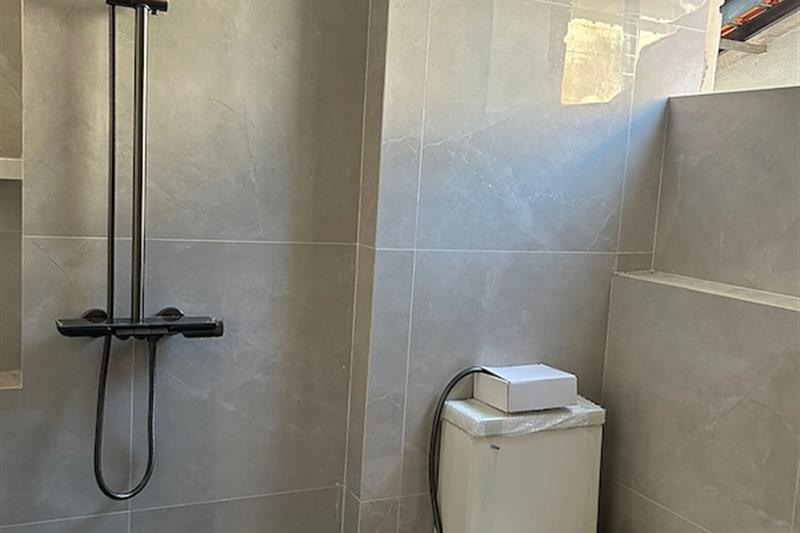
- Finishes. Proof: the tiles are laid and the fittings are fixed, not merely delivered. Boxes of tiles stacked in the porch are not a tiled bathroom. Pay for what is installed.
- Completion and handover. Proof: the approvals that apply to your works are in hand, you have walked the house with a defects list, and the last payment is not due until you have had that chance. Handover and the defects inspection, room by room covers the walk.
Wording that should make you stop
None of these is automatically wrong, but each one deserves a question before you sign:
- A large payment on signing. Ask what it pays for. A deposit that buys materials already ordered in your name is one thing. A deposit that is simply working capital for the builder is your money financing his business.
- Payments by percentage of time or "as work progresses". Neither names an event. Ask for the event.
- Payment on delivery of materials. Delivered is not installed. Ask whose risk the materials are in until they are fixed in place, and where they are stored.
- A final payment due on the day of completion. You need time to inspect before the last of your money leaves. Ask how long you have, and in what form the defects list is accepted.
- Variation work billed outside the schedule. Changes are where totals drift. The rule and the paperwork are in variation orders on a landed build.
A simple way to check a claim
When a progress claim arrives, put three things next to it before you pay: the schedule line it refers to, the proof for that line, and what you saw on site yourself. If all three agree, pay it promptly. Paying promptly for verified work is how you stay on good terms with a builder, and it is the best argument for being firm on the ones that do not agree.
Owners who keep their own record find this easy. Keep a folder with the contract and schedule, every claim, every payment, the QP's inspection records and your own site photographs. It takes minutes a week. We describe the habit in running a landed A&A as the owner. It is also the first thing anyone will ask you for if a project ever stalls, as we explain in taking over a stalled A&A project, where the gap between money paid and work standing is exactly what causes the trouble.
See what a stage looks like before you pay for it
We post dated site updates, with photographs, from our own jobs on our live jobs page. It is a useful yardstick: what a stage looks like when it is actually done, written in the plain words of the people on site. Use it to calibrate what you should be shown on your own job.
What to ask before you sign
- Can the payment schedule be rewritten so every line names an event I can check, rather than a date?
- What is the deposit, and what does it pay for?
- For each structural stage, which inspection record will I receive, and from whom?
- Are materials paid for only when installed?
- When is the last payment due, and how long do I have to inspect before it?
- If I am unhappy partway through, what do I pay for, and what happens to the work in progress?
Talk to us
If you have a quotation in hand and want a second pair of eyes on the payment schedule, WhatsApp us on 9107 2601 and tell us about your house and where the project is up to. Wong Lye Pte Ltd holds a BCA General Builder Class 2 (GB2) licence and builds A&A works, extensions and reconstructions on landed homes. See A&A works for landed homes.
Related reading: choosing an A&A contractor for a landed house · provisional sums and PC sums in a landed quotation · variation orders on a landed build