
Setting Out a Landed Rebuild: What the Surveyor Marks and Checks Before the Piling Rig Arrives
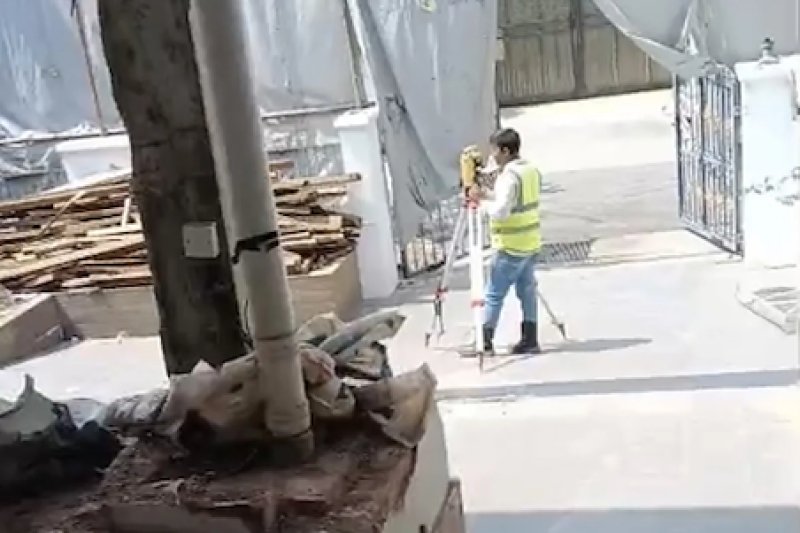
A man stands in an empty compound with a tripod, takes a reading, walks a few metres and takes another. No machine is running and nothing is being built. If you are the owner paying for the site, it is fair to wonder what the day is for. It is the day every pile on the job gets its position, and it is the one day on the programme where a mistake costs almost nothing to fix, provided it is found before the rig arrives. The question owners type is usually what happens before piling starts on a landed rebuild. This is the answer from one real job.
What "setting out" means
The structural drawings show where every pile and column goes, as dimensions on paper. Setting out is turning those dimensions into marks on the ground. It answers two separate questions:
- Where? The horizontal position of each pile and column, measured against the boundary and against each other.
- How high? A fixed reference height, a benchmark, that every later level on the job is measured from.
The instrument on the tripod does both. It is not a ceremony before the real work. Everything the rig, the rebar crew and the later trades do is measured from the marks made on this day.
What it looked like on one real job
We post dated updates from our own sites on our live jobs page. Job 22PS is a landed reconstruction, and its updates run in the order below. The wording is from the updates themselves.
- 29 July. Site checked and cleared ahead of piling works. The floor slab had been broken out and the space stripped back to the bare structure, with beams, columns and the existing staircase exposed.
- 6 September. Setting out before piling starts. The surveyor is taking levels on site, and again from the road at the front boundary. Noise barrier sheeting is up around the perimeter. Piling starts next week.
- 15 September. Piling has started. The job is 30 piles and 17 columns. A tarpaulin canopy is over the rig so the team can work in the shade, and the mixing and pumping equipment is set up in the front yard.
- 29 September. Piles being set up, with every position carefully marked and checked by our team before work continues.
Two things stand out. The setting out came nine days before the rig, and the positions were checked again by the team on site when piles were being set up weeks later. Marking the ground once and trusting it is not how a landed rebuild is run.
Why the surveyor also takes levels from the road
A level taken only inside the site tells you how high things are relative to each other on that site. It does not tell you how they sit against the street, the drain at the kerb and the houses on either side. Those are what the new house has to answer to. Shooting levels from the road as well as from the compound ties the job to the world outside the gate.
It is the same idea as the first item on the list in our note on platform level and flood risk on a landed rebuild: a survey of existing levels of the site, the road and both neighbours, done before the design is drawn. The platform level that applies to your site comes through your Qualified Person's submission. Setting out is where numbers like that stop being figures on a drawing and become heights on the ground.
Why a pile cannot be moved afterwards
A mark made with a peg and a tape can be moved in a minute. A pile cannot. Once it is cast it is part of the ground, and the columns and beams above it have been designed to land on the positions on the drawing. If a pile is found to be out of position after it is poured, the engineer has to redesign how the structure above connects to it, and that redesign is paid for by someone. The same error found on the marking day costs a few minutes with a tape.
That is why it is worth being slightly boring about this stage: a position checked by a second person before the rig starts is far cheaper than any later fix.
What has to be true before the marking starts
You cannot set out on a site that is not ready. The old structure has to be cleared far enough that nothing sits where a new pile is going. As we say in our note on who does what in a landed demolition, "demolished" is not the same as "ready to build": old footings, stumps, ground beams and whatever else was buried when the house was first built can sit exactly where a new position lands. On 22PS the 29 July update shows the slab broken out and the structure stripped back some five weeks before the setting out. The order matters: clear first, then mark.
Five questions to ask before the rig arrives
None of these need technical knowledge. They need the answers on paper.
- Who is setting out, and from which drawing? Ask for the drawing number and revision, and check it is the latest approved structural drawing and not an earlier one.
- Who checks the marks? Marks made by one person and checked by another are better than marks made once. On 22PS the update says every position was marked and checked by our team before work continued.
- Where is the benchmark, and how is it protected? Every height on the job comes from one fixed point. Ask where it is, and ask what stops a lorry or a barrow from knocking it.
- Is the finished floor level confirmed? That level comes from your QP's submission. It decides the steps at the front door and the fall of the compound, so it should be agreed before the structure is built, not discovered afterwards.
- Will you get a record? Dated photographs of the marks and a copy of the readings taken, kept on file. If a question comes up months later, a record is what answers it.
If you are the neighbour
A surveyor with a tripod on your street, or standing in the compound next door, usually means the setting-out stage. It is quiet, which makes it easy to ignore, and it comes just before the noisy phase. On 22PS the noise barrier sheeting was already up around the perimeter at this point, before any piling began.
This is also the right moment to ask for a record of your own house. A dilapidation survey is the same idea as setting out, applied to your walls: a dated baseline taken before anything moves, so that any later question has an answer.
The short version
The quiet days before the piling rig arrives are when the site is turned from drawings into marks and levels. On a real job that meant a surveyor on site and again at the road, a cleared site, 30 piles and 17 columns marked out, and positions checked again by the team before work continued. Ask who is doing it, from which drawing, who checks it, where the benchmark is, and what record you will get.
Planning a landed rebuild and want to know how the setting out and piling would be checked on your site? WhatsApp us on 9107 2601 and tell us about your house and where the project is up to. Wong Lye Pte Ltd holds a BCA General Builder Class 2 (GB2) licence and builds A&A works, extensions and reconstructions on landed homes. See A&A works for landed homes.
Related reading: platform level on a landed rebuild · who does what in a landed demolition · dilapidation survey before works start