
Staying in the House While the Builders Are In: When It Works and When It Does Not
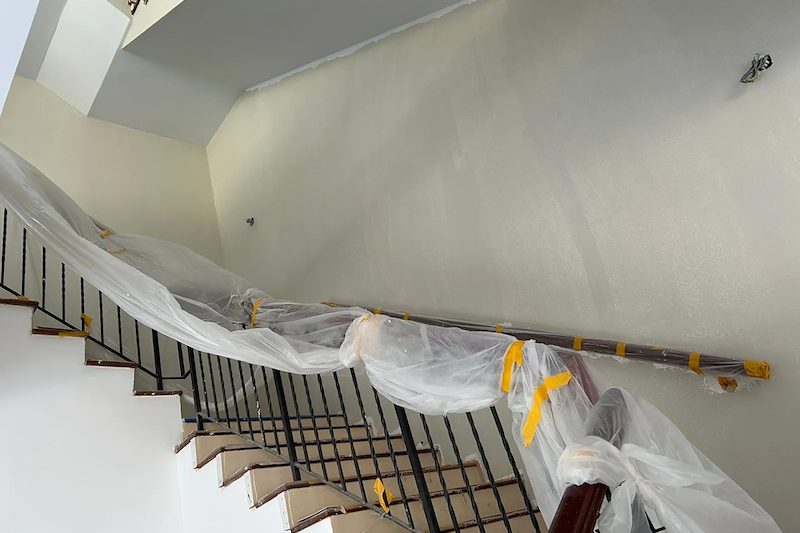
It comes up on almost every landed job, usually early, usually phrased hopefully: can we just stay in the house while you work?
The honest answer is that it depends far less on how big the job is than most people expect, and far more on two specific things. Owners tend to assume a small job means staying is fine and a big job means moving out. That is not the test.
The two questions that actually decide it
First: do the works cut structure or services above and around where you would be living? A roof coming off, structural alterations over occupied rooms, a staircase being rebuilt when it is the only one, power or water disconnected for a period — none of these are negotiable. You cannot live under an opened roof, and you cannot live in a house where the only stair is out.
Second: can the site be physically separated from the living space? Not conceptually separated — physically. A hoarding line, a door that locks, a route the trades can use that is not your hallway. If the works and the household have to share circulation, you do not have two zones. You have one site with people sleeping in it.
A large job that is confined to a rear extension with its own access can be easier to live alongside than a small job that happens to involve the main staircase.
What rules it out
- Roof removal or major roof works over occupied rooms.
- Structural work — beams, columns, slabs — above where people are living or sleeping.
- Demolition or hacking adjacent to bedrooms, on any meaningful scale.
- Extended disconnection of power or water, or works to the incoming services.
- Works to the only staircase, or to the only entrance.
- Any phase where the safe working area cannot be kept separate from the household.
Worth noting that some of these arrive late in a project rather than at the start, particularly where the scope has grown — which is a good reason to read when a project stops being A&A and becomes a reconstruction before assuming the early answer will hold to the end.
What makes it workable
The cases that genuinely work tend to share features. There is a separable part of the house — a wing, an annexe, an extension, sometimes a self-contained ground floor. It has, or can be given, its own entrance. Its services can be isolated from the works. And the hoarding can run along a line that already exists structurally, rather than across the middle of a room.
Where all of that is true, living on site can be genuinely fine, and it has a real advantage: you see the work happening daily, and questions get answered while they are still cheap to answer.
The part owners are most surprised by: it usually costs more
Staying put feels like the thrifty option, because the saving — not renting somewhere for several months — is a number you can see.
The cost you cannot see is the programme. Keeping part of the house habitable means the job has to be phased. The builder returns to the same areas more than once, works up to a live boundary instead of freely, moves the hoarding as the work moves, and keeps site facilities running for more weeks than a single continuous sequence would need. Trades that would have overlapped now follow each other.
On a lot of jobs the extra programme cost is real money, and on some of them it exceeds what the accommodation would have cost. It is not a reason not to stay. It is a reason to make the decision with both numbers in front of you rather than one, and to ask for the phased programme and the continuous programme to be priced as two options.
The compromise that usually works
The arrangement we see succeed most often is not all-or-nothing: move out for the structural and demolition phase, come back for the finishes.
That covers the window when the house is genuinely unsafe or unliveable — hacking, structural alterations, roof works, service disconnections — and avoids paying for accommodation through the long, dusty but essentially harmless tail of tiling, carpentry, painting and snagging.
It only works if it is planned. A phasing decision made week by week, on the basis of how things feel, tends to become a series of short extensions to a hotel booking made at short notice, which is the most expensive version of every option. Our note on what an A&A timeline actually looks like from first call to handover is a reasonable place to see where those phases fall.
Living with it, if you do stay
- Dust travels further than anyone expects. A hoarding stops rubble. Fine dust needs sealed openings, and it will still find its way. Assume anything soft in an adjoining room needs to be out or covered.
- Site access and your front door cannot be the same door. Settle who controls access, when, and how the site is secured at the end of each day — particularly if the household is out during working hours.
- Working hours are a genuine constraint, not a formality. They protect your neighbours from your project, and living inside it does not exempt you from them.
- Storage and the driveway. Materials arrive, spoil leaves, and both need somewhere to be. The driveway is usually the answer, which means it is usually not available for cars.
- Tell your insurer, in writing, before works start. Whether the house is occupied during building works is something they will want to know, and it is not a question your builder can answer for them.
Children, and anyone less mobile
This is where we give the same advice every time, including when it is not what the owner hoped to hear.
A live site with residents in it is a safety question before it is a comfort question. There is plant. There are openings that were not there yesterday. There are materials being carried by people who reasonably expect the area they are working in to be theirs, and a small child in that area is a hazard to themselves and to the trades.
Where there are young children or less mobile family members, move them out for any phase involving demolition, structural work or work at height — even where the rest of the household could manage perfectly well.
What to ask before you commit either way
Three things, and they are all reasonable to expect in writing:
- A phasing plan naming which rooms are habitable in which weeks.
- The hoarding line, drawn, showing where site stops and house starts at each phase.
- A services schedule: what gets cut, when, and for how long.
If those cannot be produced, nobody is in a position to promise you can stay — not because they are being evasive, but because the job has not yet been planned to the level of detail where that promise means anything. That is worth knowing early rather than discovering in week three.
The same planning discipline is what keeps the works from becoming your neighbours' problem as well, which we covered in protecting neighbours during demolition and rebuild.
Ask us before you sign a lease somewhere else
Tell us the scope and which parts of the house it touches, and we will tell you plainly whether staying is realistic, which phases you would need to be out for, and what phasing does to the programme. We would rather give you that answer before you commit to six months of accommodation you may not need — or before you commit to staying in a house you will end up leaving in a hurry. Our A&A works page covers what we do and how we are set up as a BCA General Builder Class 2 (GB2) contractor.
WhatsApp us on 9107 2601 and tell us the scope — we will give you a straight answer on whether staying is realistic.
Phasing for occupation is one kind of phasing. The other is phasing over time because the budget will not stretch to everything at once, where the question is which work has to go in first so the later work does not undo it. That is set out in doing A&A in phases on a landed house.
Related: Rebuild or A&A your landed house? How to decide — the choice that decides whether staying on site is even an option.
Related: the working hours and measured noise limits that apply to a landed build - see construction noise on a landed A&A: the hours and limits your builder must keep.