
Repainting the Outside of a Landed House in Singapore: What to Fix Before the First Coat Goes On
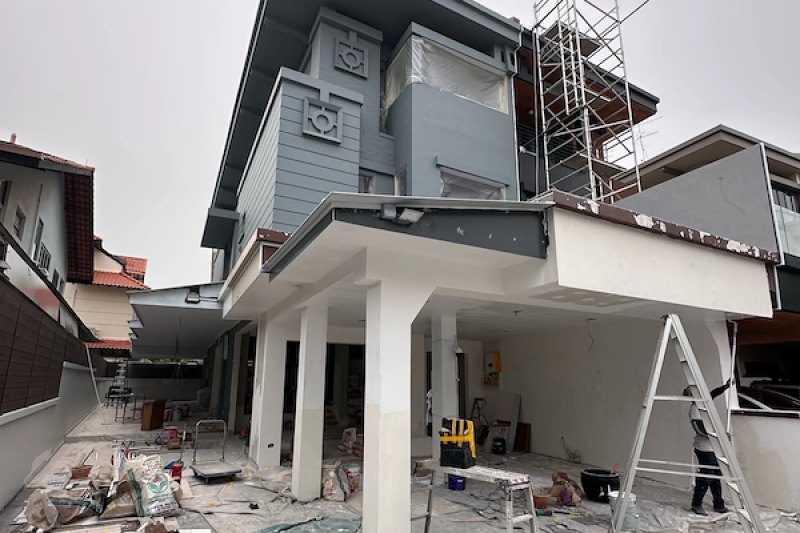
Pictured above: the front of one of our landed jobs (37EW) with the porch and soffit painted and a scaffold tower still standing at the side. The edge of the porch fascia still shows bare patches, which is a fair picture of this article: on an exterior repaint, what happens before the paint goes on is most of the job.
The owner of an older landed house in Singapore asks for quotations to repaint the outside. Three come back, and they look the same: so many coats, a named paint, a colour, a number. The quotation that wins is usually the cheapest one. Two years later the paint is flaking along the eaves, there is a pale powdery film on the north wall, and a hairline crack that was "covered" has come back through the new colour.
None of that is necessarily the paint's fault. The coat on top is the last ten per cent of an exterior repaint. The rest is what was found and fixed on the wall underneath, and a quotation that does not mention it is quoting for the wrong thing. This is what a builder looks at before the first coat goes on, and what to ask for in writing.
Walk the house first, with whoever is quoting
A fair exterior quotation is written after someone has walked all four sides, and the roof edge, with you. Ask them to point out and photograph, wall by wall:
- Cracks, and which way they run.
- Plaster that sounds hollow when tapped, or has lifted.
- Stains and rust marks running down from a balcony edge, a window head, a bracket or a gate pillar.
- Green or black growth, usually on the shaded faces and under the eaves.
- Every junction: where a wall meets the roof, a parapet meets a slab, a window frame meets the wall, a pipe goes through.
If the quotation arrives without any of that, it was written from the road. A price built that way will grow, or the work behind it will be skipped.
Cracks: some are a paint job, some are not
A crack painted over is only hidden. Whether it comes back depends on why it is there. Fine cracks in the plaster skim, with no step across them and no stain, are normally a surface repair: cut open, filled and primed. A crack that runs diagonally out of the corner of a window, steps through the joints of the brickwork, or is wider at one end is a different conversation, and on those the structural call belongs to an engineer, not to a painter or to us. Our article on when a crack on a landed house needs an engineer sets out the questions that sort one from the other.
For the quotation, the useful question is simple: what is your allowance for crack repair, and what happens if you find one you are not comfortable painting over? A contractor who says "we will fill everything" has not told you how a moving crack is handled. A contractor who says "we will flag it to you before we close it up" has.
Loose plaster and dampness come out, they do not get painted
Paint holds to what is behind it. Where plaster has lost its bond to the wall, a new film of paint simply goes with it when the plaster falls. The usual way to find out is to tap the wall, mark every hollow-sounding patch, cut it back to sound material and re-plaster it. That is slow, dirty and invisible once finished, which is exactly why it is the line most often squeezed out of a cheap quotation.
Damp is the other hidden item. A wall that is wet because water is getting in from a failed joint, a blocked gutter or a leaking pipe will blister whatever is put on it. If a stain shows up under a window or below a roof edge, the entry point has to be found and fixed first. Painting a leak is the most expensive way of discovering that it was a leak.
Wash, treat, prime: the dull middle
Between "walk the house" and "first coat" there is a sequence that cannot be shortened without a price in later years. The surface is washed down, growth is treated and removed rather than rolled over, filler and patching are allowed to cure, and the repaired areas are primed so they do not take the finish coat differently from the old wall. Ask the contractor to list that sequence in the quotation, in their own words, and to say who signs off each wall before the next stage starts.
The same applies to steel on the outside of the house. Gate, railings and awning frames have their own corrosion story, covered in our piece on galvanised against painted steel outdoors. A repaint that colours over a rust bloom on a railing has the same short life as paint over a crack.
Scaffold, access and the neighbours
The upper floors of a landed house cannot be reached from a ladder. That means scaffolding, and on a terrace or semi-detached house it often means scaffolding on or next to the boundary. Work out early who is arranging it, how long it stays up, and whether you need to speak to the neighbour. Our note on what a neighbour can reasonably ask during building works next door is written from the other side of the wall, and it is useful to read from yours: a short, polite word before the scaffold goes up costs nothing, and paint overspray, dust from washing down and a scaffold on the boundary are all things the neighbour will notice first.
Protecting what is already finished matters as much. Windows, glass, aluminium frames, new gates, car porch floors and planters all need covering before washing down or spraying starts. If something is marked, the contract decides who pays, which is why it belongs in the quotation. Our article on who is responsible when a finished surface is damaged goes through how to write that down.
The warranty line, and what it does and does not say
On our landed work the warranty is seven years on what we build, with one exception that is published on our landed A&A works page: exterior wall painting is quoted at five years, because five years is Nippon's own warranty on the product, and we will not put a longer number on something than its maker will stand behind. Two points follow for any quotation you compare, ours or anyone else's.
- A longer number is only worth the condition behind it. Ask who stands behind it, what it covers (peeling and blistering, or colour fade too), and what it excludes. A warranty on paint does not rescue a wall that was never prepared.
- The warranty is not wear and tear cover. It answers a fault in the work, not ordinary weathering, and a Singapore exterior in sun and storms does weather.
Colour: decide on the wall, not the swatch
A swatch seen indoors does not look the same on a three-storey wall in the afternoon. Ask for a trial patch on a wall that gets real sun, look at it in the morning and late afternoon, and only then sign off. If your house has a dark colour on a shaded face and a light one on the sunny face, a patch on each costs one afternoon and settles the argument before it costs a scaffold.
Eight things to have in the quotation
- A walk of all four sides with photographs of what was found.
- An allowance and a method for crack repair, and how a crack that looks structural is flagged to you.
- How hollow plaster is found and cut out, and how it is priced if there is more than allowed.
- How damp or a leak is traced before any paint goes near it.
- The preparation sequence, and who signs off each wall.
- Who arranges the scaffold, how long it stays and how the neighbours are told.
- What is covered and protected, and who pays if something is marked.
- The paint named, the number of coats, the warranty period and who stands behind it.
If you are repainting an older landed house and want a straight view on what the walls need before a colour is chosen, send us photographs of each side, the roof edge and any stain or crack that worries you. We will tell you what we can and cannot judge from them. Where the repaint is part of a wider landed A&A, our landed A&A works page sets out how we work.