
Asbestos in an Older Landed House: What Happens When It Turns Up
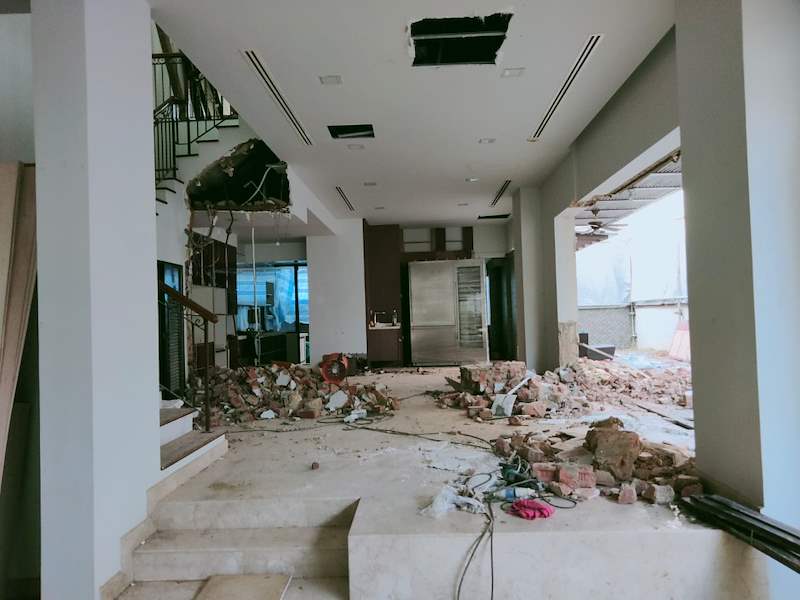
Most surprises on a landed job are matters of degree. The soil is worse than expected, the neighbour's wall is closer than the survey suggested, a beam is where nobody drew one. They cost time and money and the job goes on.
Asbestos is not one of those. It is the discovery that stops the site, and the only one where the correct response on finding it is to put the tools down and call somebody else.
The good news, if there is any, is that it is the most predictable surprise there is. It is a function of the age of the house, which is known before anyone quotes.
What the law actually requires
Two things matter, and they are both straightforward.
First, under Singapore's Workplace Safety and Health (Asbestos) Regulations, asbestos-removal work may only be carried out by a MOM Approved Asbestos-Removal Contractor. Not the builder. Not the demolition crew. Not the owner with a mask on. MOM publishes the list of approved contractors on its own website, and that is the list a name should be checked against.
Second, the approved contractor must notify MOM at least one week before removal work begins. That week is a real programme item, and it sits on top of everything before it: identifying the material, appointing the contractor, agreeing a method.
And the ordering rule that follows from both: asbestos-containing material has to come out before the building is demolished. So on an older house, this is not a step somewhere in the middle of the works. It is at the front, ahead of the machine arriving.
Which houses this applies to
Occupational asbestos exposure in Singapore arises mainly during the demolition and renovation of buildings put up before 1989. So the question is answered largely by the age of the house: a 1960s, 1970s or early 1980s property that has never been comprehensively rebuilt is the one to check.
Two qualifications worth stating plainly. A house of that age that has had substantial works since is not automatically clear — later work is often built over original material rather than instead of it, and the roof void and service areas are exactly where nobody bothered. And a material that looks like asbestos cement is not proof of anything, because visually identical products were made without it. Age tells you to look. Only proper identification tells you what is there.
Where it hides in a house of that era
Historically the materials used in buildings of that age included cement roof and eaves sheeting, ceiling and partition boards, lagging around pipework and tanks, some floor tiles and the adhesive beneath them, and assorted flat sheet in service areas and outbuildings.
Read that list again and notice what it has in common: every single item is something a demolition crew handles in the first hour of the first day. Roof sheets come off first. Ceilings come down early. The store room at the back gets cleared before anything else. Which is precisely why the survey has to come before the crew, and not the other way round.
The expensive version of this story
It runs the same way every time. Demolition starts on a Monday. Somebody notices the roof sheeting, or a neighbour does, or the material simply looks wrong. Work stops. Nobody can lawfully touch what has already been disturbed. The house now needs identification, then an approved contractor, then a week's notice to MOM, then the removal — and only then does the demolition everyone thought was starting on Monday actually start.
Meanwhile the site is standing, and standing sites are where money goes quietly. The hoarding is up, the neighbours have been told a date, and the whole downstream programme moves.
Nothing in that sequence was unforeseeable. The house was always seventy years old.
The version that costs almost nothing
Establish it before demolition is programmed. On a house of the relevant age, the survey goes in the early sequence alongside the dilapidation survey of the neighbours and the site set-up. If the result is clear, you have lost a few days at a stage where a few days cost nothing. If it is not clear, you have found out while the programme still has room to absorb it, and while it is a line in the budget rather than a stopped site.
Three practical points that make the difference:
- Do not let anyone "check" by breaking a piece off. Disturbing the material is the thing that creates the risk. If it is suspected, it stops being touched.
- Keep the appointments separate. Asbestos removal is a specialist appointment against MOM's approved list, and it is not a line item inside a builder's rate. Our position on that is the same as our position on everything else we do not publish a price for — see why we do not publish a price list.
- Ask about it when you are buying. If you are looking at an older landed property to rebuild, the age of the house is a budget question as much as an approvals one. It belongs beside reading the A&A approval history before you commit.
What identification actually involves
Owners often expect this to be a large exercise. It usually is not. Someone competent walks the house looking specifically for the materials on the list above, takes samples of anything suspected, and has them identified properly. What comes back is a record of what was found and where — which is the document the removal contractor needs in order to price and plan the work, and the document that lets everyone else stop guessing.
Two things about that record are worth knowing. It is only as good as the access the surveyor had: sealed roof voids, boxed-in service ducts and locked outbuildings are exactly where original material survives, and a survey that could not get into them says so rather than saying the house is clear. And it is the basis of the method statement — how the material will be taken down, how the area will be enclosed, how the waste leaves the site. That method is the removal contractor's to write, not the builder's to assume.
What changes on site during removal
While removal is happening, that part of the house is not a normal building site. The work area is enclosed and restricted, other trades are off it, and the owner does not walk through it either. Access, storage and the crane or lorry positions all have to work around it, which is another reason it belongs at the front of the programme rather than dropped into the middle of one.
The neighbours are the other half of it. On a tight landed plot they are close enough to see everything, and an unexplained enclosure with restricted access invites exactly the phone call you would rather not receive. Telling them in advance what it is and when it finishes costs nothing and prevents a great deal — the same principle set out in protecting neighbours during demolition and rebuild.
Four questions before you accept a demolition date
- When was the house built? If the answer is before 1989 and nobody has raised this, that is the answer to your next question.
- Has the house been surveyed for asbestos, and can I see the record? Not "do you think there is any".
- If material is found, who is the approved contractor and are they on MOM's list? The list is public and takes a minute to check.
- Does the programme include the notification week and the removal itself? A demolition date that assumes a clear house is a date, not a plan.
What a builder is actually for here
We are not an approved asbestos-removal contractor and we would not pretend otherwise — that is a specific approval held by specific firms, and MOM keeps the list precisely so that nobody has to take a builder's word for it.
What a builder is for is knowing that the question exists, raising it before it becomes an incident, sequencing the survey and the removal into the programme so the demolition date is real, and making sure that when the material is found the site stops rather than carries on. On an older house that is not caution. It is the difference between a programme and a wish.
It is also, quietly, part of what separates a builder from a contractor with a machine. The things that go wrong on landed sites are rarely exotic — they are the known risks nobody put on the programme. This one has a date stamped on the house.
If you are looking at an older house
Tell us roughly when it was built and what you intend to do with it, and we will tell you where this sits in the sequence and what has to happen before a demolition date can be treated as real. Confirm the current requirements with MOM, which is the authority on what applies and can change them.
WhatsApp us on 9107 2601 with the property type, the area and roughly the age of the house — we will give you a straight answer on the sequence, and on whether A&A works or a fuller reconstruction is the honest description of what you are planning.
Related: asbestos sits inside a wider demolition scope, and the boundaries of that scope are where quotations diverge — see demolition on a landed rebuild: whose scope it is, and where it stops.