
Utilities on a Landed Rebuild: What Happens to Your Power and Water
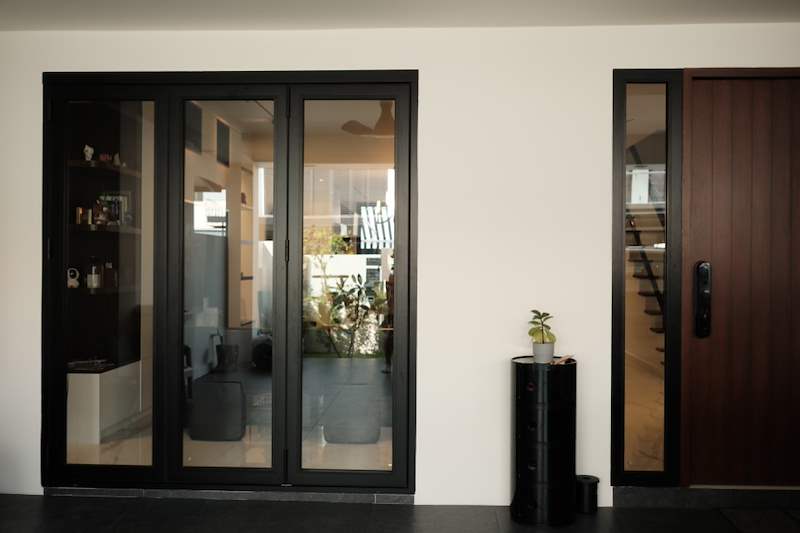
Pictured above: a completed terrace house A&A from our project archive (3TBA). The services behind a frontage like this are decided long before the house looks like this.
Owners planning an A&A or a rebuild think about the structure, the layout and the finishes. Almost nobody asks the question that causes the most avoidable delay on a landed site: what happens to the electricity and the water while the house is being built, and who is arranging it.
It sounds like an administrative detail. It is not. Supply is the one part of a landed project that your builder cannot simply do faster by putting more men on site — it involves the utility, a licensed electrical worker, and in some cases your neighbour's goodwill. When it is left until the week the hoarding goes up, the site sits idle waiting for power, and every trade behind it moves.
The part that surprises people
An occupied house has a live electrical supply and a water supply, both registered to an account, both running through a meter that belongs to the utility rather than to you. A rebuild, and often a substantial A&A, will disturb both — the intake position moves, the meter position moves, or the wall it sits on is coming down.
So there are really three separate supplies to think about, and they do not arrive at the same time:
- The supply you have now, serving the house as it stands.
- A temporary supply for the construction period, which powers tools, lighting, hoists and site accommodation.
- The permanent supply to the finished house, which is usually larger than the old one because the new house has more of everything.
Each of those is a separate arrangement with its own lead time. Treating them as one item on a programme is where the delay comes from.
Electricity: who actually does what
In Singapore the electricity network and the meter are SP Group's. The wiring inside your boundary is the responsibility of a Licensed Electrical Worker (LEW), and for anything beyond the smallest installation the LEW is the person who signs off the installation and makes the application for supply to be turned on. Your builder does not replace that role and neither does your architect.
The practical consequence is simple and worth writing down: an LEW needs to be appointed earlier than most owners appoint one. Owners tend to think of the electrician as a finishing trade who turns up when the walls are ready. On a rebuild, the LEW is involved at the start, because the application for the new supply and the arrangements around the old one both run through them.
Ask your builder, in writing, at the point of award:
- Who is appointing the LEW, and at what stage.
- Who is arranging the temporary construction supply, and whether its cost is in the tender or excluded.
- What happens to the existing account and meter before demolition starts.
- Who applies for the permanent supply to the new house, and when that application is submitted relative to the programme.
- Whether the new supply capacity has been decided, and on what basis.
The last one matters more than it looks. The capacity of the incoming supply is set early and is awkward to change later, and the new house almost always asks more of it than the old one did — more air-conditioning, an induction hob, a lift if you are adding one, a car charger, possibly solar. If nobody has totalled that up before the application goes in, the number that gets applied for is a guess, and a guess is a bad thing to discover at commissioning.
Water: less paperwork, more sequencing
Water is usually the simpler of the two, but it has the same shape. There is an existing supply and meter serving the house, there is water needed on site throughout construction, and there is the final connection to the new house.
Two things catch people out here. The first is that construction needs water — for mixing, for cleaning, for wetting down. If the existing supply is cut at the start and nothing replaces it, that becomes a daily problem nobody priced. The second is that the position of the incoming water service and the meter is a design decision, and it is far cheaper to get it right on the drawing than to move it after the driveway and boundary wall are built.
The neighbour question on a terrace or semi-detached
On an inter-terrace or semi-detached house, the services and the meters often sit in a position that is tight against the boundary, and the work to move or reconnect them may need access from next door, or at least their tolerance while it happens. That is the same conversation as the one about scaffolding, hoarding and the party wall, and it goes far better when it happens early and in person rather than on the morning a contractor needs to stand on their driveway.
If you are already having the dilapidation and boundary conversation with your neighbour — and on a terrace you should be — add services to the list while you are there.
What goes wrong, in the order it usually goes wrong
- The LEW is appointed late. Everything downstream of the supply application then sits behind it.
- Nobody owns the temporary supply. The builder assumed it was the owner's, the owner assumed it was in the contract. Both assumed, neither asked.
- The new supply capacity is guessed. It is sized against the old house, or against a floor area, rather than against what the new house will actually run.
- The meter position is decided on site. It ends up somewhere the architect never drew, and it is the first thing visitors see.
- The final connection is treated as a finishing item. It is not. It has a lead time that does not care how close you are to moving in.
None of those are technically difficult. All of them are scheduling failures, and all of them are avoided by asking the five questions above before work starts rather than after.
Where this sits in the programme
The honest summary is that utilities belong with the first set of decisions, alongside demolition scope and structure, not with the finishing trades. They get buried behind walls, under driveways and inside boundary structures, which puts them squarely in the category of work that has to be right the first time. If you are phasing an A&A, the same rule applies with more force: anything buried or built over goes in phase one, and incoming services are about as buried as it gets.
We cannot tell you what the current requirements, lead times or charges are for your specific address — those are set by the utility and confirmed by your LEW, and they change. What we can tell you is that the projects where this is painless are the ones where somebody was made responsible for it in writing at the start.
Before you sign the builder's contract
- Confirm in writing who appoints the LEW and when.
- Confirm whether temporary power and water for the site are included or excluded.
- Confirm who applies for the permanent supply, and at what stage.
- Have the new supply capacity worked out against the actual equipment list for the finished house, not estimated.
- Have the intake and meter positions shown on the drawings, not left to site.
- On a terrace or semi-detached, raise access with your neighbour at the same time as scaffolding and dilapidation.
Planning an A&A or a rebuild and want this sorted before it becomes a delay? WhatsApp us on 9107 2601. Tell us the house and the scope and we will tell you what needs to be arranged, in what order, and who has to do it. Wong Lye Pte Ltd holds a BCA General Builder Class 2 (GB2) licence and builds A&A works, reconstructions and extensions on landed homes across Singapore. See A&A works for landed homes.
Related reading: demolition scope on a landed rebuild · rewiring before the walls close · phasing an A&A