
Windows in a Landed A&A in Singapore: What the Opening Must Be Before the Frame Goes In, and What to Check Before the Fitter Leaves
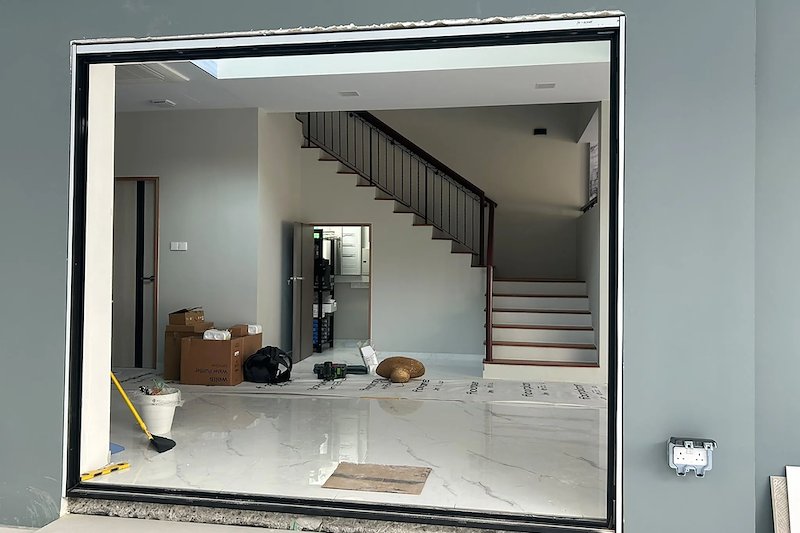
Pictured above: a dark-framed window set into its opening on our landed job 37EW, with the protective sheets still down on the marble-look floor behind it. The frame is in, but the edge between the frame and the wall has not been finished yet. Our site update of 4 November on the Live Jobs page records that the windows and glass panels are in.
A window is the one part of a landed house that is ordered like a product and built like a hole in a wall. People spend weeks on the frame colour and the glass, and about ten minutes on the opening it goes into. Then the frame arrives, the fitter sets it in, and any difference between the product and the hole gets filled with sealant by whoever is standing there.
This article is about the hole, and about the hour after the frame is in. It uses what our own updates on 37EW show, and gives you the checks that cost nothing to ask for and a lot to fix later.
What 37EW's updates show, in order
37EW is a three-storey semi-detached house we are finishing. These dates come from our own Live Jobs updates, so you can see the order of work rather than take our word for it.
- 22 July. We are forming the window and door openings and smoothing the wall around them, ready for installation.
- 29 September. The window openings are wrapped in plastic sheeting ahead of the vinyl flooring that weekend, so the floor trade works with the openings protected.
- 4 November. Windows and glass panels are in, and the bathroom fittings are going up.
Two things stand out. The opening was formed and smoothed about three and a half months before the window update, and it was covered up during that wait. And the windows were recorded as in after the floors, not before. Both are choices, and both are worth asking your own builder about.
Before the frame goes in: what the opening must be
An opening in a landed house is brick or concrete with plaster around it. None of it is cut to a drawing's precision, so the built opening is a few millimetres different from the drawing in every direction, and it may not be perfectly square. A plain window absorbs that in the gap around the frame. The gap is there on purpose. What matters is that it is even, and that someone has looked at it before the frame is made, not after.
Ask these questions while the opening is still bare:
- Who measures the finished opening, and when? The sensible order is that the opening is formed and plastered, the window supplier measures what was really built, and only then is the frame made. A frame ordered from the drawing leaves someone to hack or pack the opening to fit at the worst moment.
- Is the opening plumb, level and square? A frame set into a twisted opening will rub or leave a gap that opens at one corner. Tell the builder you want this checked before the fitter arrives, not found by the fitter.
- What is the sill height against the finished floor and the tiles? In a bathroom, the tile is cut around the window opening. The sill height, the tile layout and the window all have to agree before the tiler starts, or the cut tile ends up in the wrong place. Our article on what to agree before owner-supplied fittings arrive covers the same habit of settling positions first.
- What is above the opening? A wide opening needs something carrying the load over it. That is a structural question and it is covered in the steel behind a big front door and glass wall. Settle it before anything in this article matters.
The gap around the frame is where the leaks start
Look at the photograph again. The frame sits in the opening with a gap around it, and the edge is still raw. That gap gets closed in stages: something fills it, something seals it on the outside, and the wall is made good around it. If any one of those is skipped or done badly, rain gets in at the edge of the frame, not through the glass. That is why a window can look perfect and still stain the wall under it.
So ask your builder, in plain words:
- What closes the gap between the frame and the wall, and who does it?
- What seals it on the outside, and who checks it before the scaffold or the access comes down?
- Is the edge made good, plastered and painted, before or after the frame is fitted?
The answer you want is a name and a stage, not "the fitter will handle it". The same questions, for the rest of the house, are in our article on where waterproofing fails on landed homes. A window edge is one of those places.
Protecting the frames while the other trades finish
A window fitted early has to survive every trade that comes after it. On 37EW the bathroom window in the same 4 November set of photos still has tape on the frame and on the glass. That tape is there for the painters, tilers and cleaners, and it should stay on until the last of them has gone.
The usual damage is not dramatic. Paint splashed on the frame, scratched aluminium, a chipped corner, cement slurry dried on the glass. Our article on who is responsible for damage between trades sets out who should answer for it. For windows, the practical step is to agree one thing at the start: the frame and glass are inspected and photographed when they are fitted, so there is a record of what condition they were in on the day.
Before the fitter leaves: the walk-through
Do this with the fitter present, while the tape is still on and before the window is signed off. It takes about ten minutes per room.
- Open and close every sash, all the way, three times. It should move freely and stop where you put it. A sash that is stiff on day one will be worse in a year.
- Lock every latch. It should catch without lifting or pushing the sash. If you have to lean on it, the frame is out of line.
- Look at the frame against the wall. The gap should be even all round. A gap that is wide at one corner and tight at another means the opening or the frame is out of square.
- Look at the glass from an angle. Scratches and chips show up in side light. Note them now.
- Check for drain slots or vents on the frame. If your window has them, they should be clear and facing the right way. Ask the fitter to show you which they are.
- Ask what the glass is. Clear, frosted or otherwise, and whether it is toughened or laminated. Ask for it in writing, not from memory.
On fixed glass panels, which do not open, there is less to test and more to look at: the glass itself, the edges and how it is held in the frame.
A bathroom window is its own decision
In a bathroom the window is next to water and next to the tiler. Decide before the tiling starts where the window sits relative to the shower and the toilet, what the glass looks like from outside, and whether the window opens or is fixed. On 37EW the window sits in a tiled opening and the bathroom fittings were going up in the same update. Moving a bathroom window after the tile is up means breaking tile, so settle it first.
The honest limit of one job
37EW is one house, and the dates above are what that job did. A job with a late design change, a longer wait for the frames or a different wall build will take a different order. What carries over is the sequence of questions: measure the real opening, settle what closes and seals the gap, protect the frames, then walk through every window before the fitter leaves. If the order on your job is different, ask why.
Next step
If you are planning windows on a landed A&A, start with our A&A works for landed homes page. For the doors that open the house up to the garden, read folding glass doors: what the opening, the track and the threshold must be ready for. Or send us your window schedule and elevation drawings on WhatsApp, and we will tell you what we would settle before the frames are ordered.