
Steel Delivered Before the Installers Arrive: Count It, Check It and Store It Properly in a Singapore Warehouse
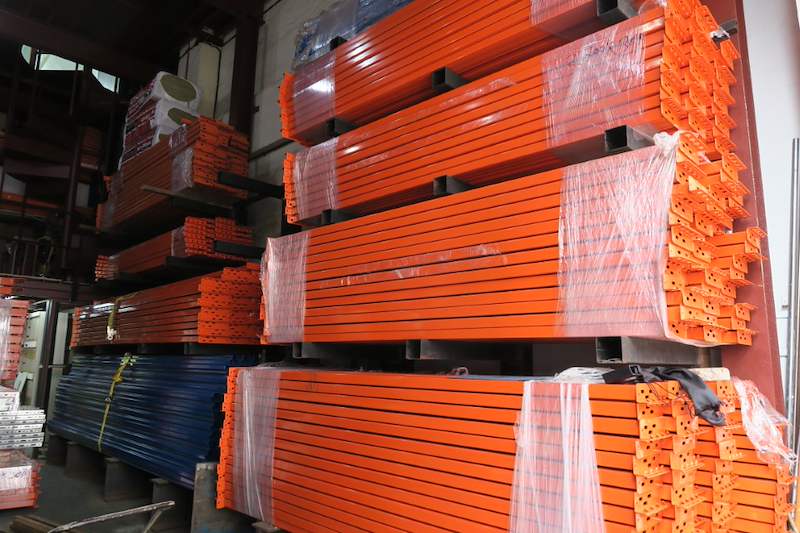
Pictured above: racking beams stacked and shrink-wrapped in a warehouse, from our metal-works project archive (M12), for illustration. This is how steel for a racking or mezzanine job looks in the days before anyone starts installing it, and this is the stage this article is about.
When you order racking, a steel frame or the steel for a mezzanine, the steel does not arrive on the day the installers do. It arrives first. It comes on a lorry, it is unloaded somewhere in or beside your unit, and then it sits, sometimes for days and sometimes for weeks, while the floor is finished, the approvals are cleared or the crew finishes the previous job. In that gap it is easy for nobody to be responsible for it.
That gap is where a surprising number of small problems start: a bundle that was short and nobody noticed, an upright with a bent flange that was signed for anyway, beams stacked against a fire exit, or a bundle of painted steel left in a wet corner. None of it is difficult. It just needs someone to decide, before the lorry arrives, what happens when it does. This article is about those decisions, in the order they come up.
It is written for an owner or operator who is buying steel for a warehouse or industrial unit in Singapore, and it applies whether the steel is racking, a portal frame, a mezzanine or a canopy. It does not cover how the steel is designed or what the floor must carry; those are covered in what to settle before the floor slab is poured and in the steel package in a warehouse build, and they come first. What follows is the part between the factory gate and the first beam going up.
Before the lorry comes: who receives it, and with what?
The first question is the plainest one: when the lorry arrives, who is standing there, and what will they unload it with? A bundle of racking beams or a stack of upright frames is not something a person lifts. It comes off with a forklift, a crane lorry or a loader, and someone has to have arranged that.
Ask these before the delivery date is fixed:
- Who unloads, the supplier's driver and crew or your own people? If it is you, is there a forklift and an operator available at the delivery time, and is the forklift suitable for the length of the bundles?
- Can the lorry actually reach the door? Check the access road, the turning space, the height of the loading bay or shutter and whether the lorry has to share the bay with your own inbound goods that morning.
- If the unit is in a multi-user industrial building, does the building management need notice for a large vehicle, and which corridors or ramps will the load cross?
- Who is authorised to sign for the delivery? It should be someone who will actually count the goods, not whoever happens to be at the front desk.
If your warehouse is working while the steel arrives, this is also the moment to separate the steel delivery from your own traffic. Containers arriving through the same door at the same hour is a scheduling problem, not a steel problem. We cover that further in steel works inside a working warehouse.
Count it against the order, not against the pile
The moment the steel is down is the cheapest moment to find out what is missing. Once the lorry has left and the bundles have been moved into a corner, a shortage becomes an argument about when it went missing.
Count against the delivery order or packing list, item by item, and against the quotation behind it:
- The main members: how many beams, how many upright frames, how many deck panels or decking sheets, in each length and type listed.
- The small items that are easy to forget because they come in boxes or bags: base plates, pins, bolts, braces and anchors, where the job uses them.
- Anything that was supposed to be delivered later. If part of the order is coming in a second delivery, the packing list should say so, so that a shortage on the first load is not a surprise.
Do not count by eye across the top of a stacked bundle. Shrink-wrapped bundles hide their ends, and a bundle that looks complete from one side can be short at the other. Ask for the count to be made against the list, and keep a copy of the list that was signed.
Look at the steel, not just the number
A correct count of damaged steel is still a problem. While the bundles are on the ground and the driver is still there, look at the condition of what came off the lorry:
- Bent or crushed ends on beams and uprights, and dented faces.
- Coating that has been chipped, scraped or rubbed through to bare steel, which matters most on painted steel that will stand outdoors or in a damp unit. If you are choosing between finishes, galvanised, painted or powder-coated steel explains what each one is for.
- Wet or rust-stained wrapping, which can mean the load was rained on and water has been sitting against the steel.
- Bundles that have shifted or been strapped badly, so that members have rubbed against each other in transit.
Write any damage or shortage on the delivery order before you sign it, and take photographs with the delivery order in the frame. This is ordinary practice and it protects both sides: the supplier knows what to replace, and you are not left holding a dispute about when the damage happened. A bent member is not something to straighten on site; if it is structural, it goes back.
Where it waits matters more than people expect
A bundle of steel is heavy and it will sit where it is put. Decide the place before the lorry arrives, not while the forklift is holding the load.
- Off the ground. Steel stored flat on the floor sits in whatever water the floor collects. Bearers under each bundle, as in the photograph, keep the steel clear of the slab and let the forklift forks get under it again.
- Under cover and dry. Keep the wrapping on until the steel is needed, and do not leave it where rain blows in at a shutter or where a leaking roof drips.
- On a floor that can take it. A stacked bundle puts a great deal of weight onto a small area. If the slab is new, has not been signed off for load or is the same slab the racking will later stand on, ask before you stack there. This is the same question as the floor-slab one, asked earlier than people expect.
- Clear of what must stay clear. Fire exits, escape routes, sprinkler heads, electrical panels, shutters and the aisle the forklift actually uses. Steel parked in a convenient corridor tends to stay there.
- Stacked the way it was packed. Do not restack bundles higher than they were delivered, and do not pull members from the bottom of a stack. Heavy beams that slide are a danger to whoever is nearby.
Also decide who may move it. A forklift operator who is not part of the installation crew, moving bundles to clear a path for stock, is how a stacked bundle ends up damaged or unevenly supported.
Label it for the layout, so nobody hunts for it
Steel for a racking system or a frame is not interchangeable. Beams come in different lengths for different bays; uprights are different heights and may be different strengths for different positions. If the bundles are not marked against the layout drawing, the installers spend their first day sorting.
Ask the supplier, before delivery, how the bundles will be identified: by bay, by level or by drawing reference. Ask for the layout drawing with those references to be on the delivery paperwork. If you are the one who will receive it, keep a copy on site where the installers can find it.
Who is responsible while it waits?
This is the question most owners find they have not asked. From the moment the lorry unloads in your unit until the installers take over, the steel is physically in your premises. If a bundle is damaged by your own forklift, stolen, or soaked by a leak, who carries that?
There is no single right answer. It depends on the supply terms, on whether the steel has been paid for and on the cover each party holds. What matters is that the question is asked and answered in writing before the delivery date, not discovered afterwards. Ask the supplier when ownership and risk pass to you, and ask whoever is installing when responsibility passes to them.
Hand it over properly
On the day the installers arrive, the steel should be accompanied by three things: the signed delivery order or orders, a short note of any damage and any shortage with its status, and the layout drawing with the bundle references. It takes ten minutes to put together and saves the first morning of the install. If something is missing or damaged, the installers can plan around it rather than finding out when they reach that bay.
What goes wrong, and when you find out
- A shortage of small parts, found when the crew is on site and waiting.
- A damaged upright or beam, signed for without a note, so the replacement becomes a dispute.
- Painted steel stored in a damp corner, with wrapping that kept the water in rather than out.
- Bundles stacked on a slab that was never meant to take them.
- Steel left across an escape route or in front of a panel, then moved in a hurry by someone else.
- Bundles with no marking, so installation starts by sorting.
Almost all of these are found on the day installation starts, which is the most expensive day to find them.
Questions to ask before the delivery date
- Who is unloading, with what, and is the lorry able to reach the door?
- Who will sign for the delivery, and will that person count against the list?
- Is any part of the order arriving later, and does the packing list say so?
- Where will the steel wait, is it dry, is it off the floor and can the floor take it?
- Is anything stacked across an escape route, a panel or the forklift aisle?
- How will each bundle be identified against the layout?
- When do ownership and risk for the steel pass to you, and when do they pass to the installer?
The short version
- Decide who unloads, with what and where it goes before the lorry is booked.
- Count against the delivery order, item by item, including the small parts.
- Look at the steel as well as the number, and write damage and shortages on the order before you sign.
- Store it off the floor, dry, on a floor that can take it and clear of anything that must stay clear.
- Label bundles against the layout, and agree in writing who is responsible while it waits.
If you are buying steel for a warehouse or industrial unit and want to know what to settle before it is delivered, see our metal works page for the kind of steelwork we fabricate.
If steel is about to be delivered to your unit, WhatsApp us on 9107 2601. Tell us what is being delivered, when and where it will wait, and we will tell you what to check first. Wong Lye Pte Ltd holds a BCA General Builder Class 2 (GB2) licence.