
Re-Roofing an Old Landed House in Singapore: Patch or Replace, and What the Timber and Steel Underneath Decide
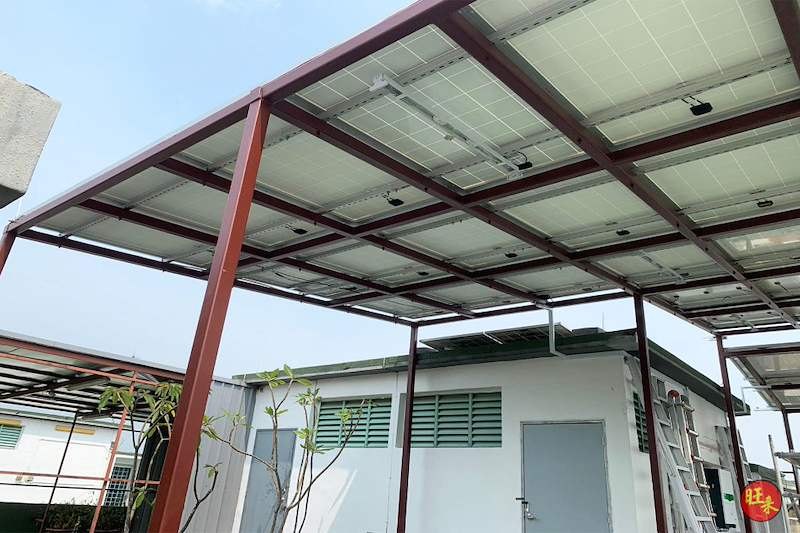
Pictured above: the steel frame of a rooftop canopy on one of our projects (M28), seen from underneath, with the solar panels forming its roof deck. It is a useful reminder that a roof is a structure first and a covering second: the posts, rafters and purlins decide what the covering can be.
An older landed house gets a brown stain on a bedroom ceiling after a heavy storm. A roofer is called, a few tiles are replaced or a patch of sealant goes on, and the stain dries. Then it comes back, in a different corner, after the next storm. By the third time the owner is asking the question this article is about: should the roof be patched again, or replaced?
The honest answer is that nobody can say from the ground. The leak you see is rarely where the water gets in, and what decides patch or replace is mostly hidden: the timber or steel under the covering, and how the roof was joined to the walls. This is how a builder reads those clues, and what to put in writing before anyone strips a single tile.
First: find where the water actually gets in
Water does not drop straight down from the hole. On a pitched roof it runs along a batten or a rafter before it finds a gap in the ceiling. On a flat concrete roof it can travel along the top of the slab, or under a failed membrane, and come through a wall or a ceiling metres from the real entry point. So the position of the stain is a clue, not an address.
Before any decision, ask whoever inspects the roof to show you, in photographs, three things:
- The entry point they believe in, and how they know. "Cracked tile above the stain" is a guess unless water was traced to it.
- The condition of the layer under the covering: the underlay, the battens and the rafters on a pitched roof, or the screed and the membrane on a flat one.
- Every junction: the ridge, the valley, where the roof meets a wall, the roof outlets and gutters, and any penetration for a pipe, vent or bracket. Junctions fail far more often than the middle of a roof.
If the answer to all three is "we did not look, we just saw the stain", the quotation that follows is a guess, however neat the number.
What points to a patch, and what points to a replacement
A patch is a sensible answer when the problem is one identifiable thing and the structure underneath is sound. A replacement is the better answer when the covering is only the visible part of a wider failure. These are the signs a builder weighs:
Leans towards a patch:
- One entry point, traced and photographed, such as a single cracked tile, a failed flashing at one junction or one blocked outlet.
- The battens and rafters, once a few tiles are lifted, are dry and firm.
- The leak started after something specific, such as a tree branch, a satellite dish or an earlier repair.
Leans towards a replacement:
- Leaks that move around the house from storm to storm. That pattern usually means the covering or the waterproofing is failing as a whole, not at a point.
- Cracked or slipped tiles in many places, or a ridge or eave line that has visibly sagged or waved.
- Soft, dark or crumbling timber when a few tiles are lifted, or rust scale on steel purlins and truss connections.
- Earlier patches that are themselves failing. A roof with layers of sealant on it has been fighting the same problem for years.
One caution: the cheapest patch can be the most expensive decision if the structure underneath is quietly rotting. Water that is kept out of the ceiling but left inside the roof timber has not been fixed, only hidden.
The part that surprises owners: the roof structure is exposed the day the covering comes off
A re-roof is not just new tiles. The moment the old covering is removed, the structure underneath is open to inspection for the first time in decades, and that is when the real scope is decided. On a pitched roof, this is usually where timber that has rotted, been attacked by termites or been wetted for years is found. On a steel-framed roof it is where rust at connections shows. On a flat roof it is where a soaked, failed screed is found under a membrane that looked fine from above.
Which means a fixed quotation for "replace roof" is only as good as its assumptions. Ask how the quotation treats what is found underneath:
- Is repair of rotten timber or corroded steel included, excluded or a provisional item, and who decides when it is needed?
- Will the exposed structure be photographed before the new layers close it up, so you hold a record of what was there?
- If termite damage is found, what is the treatment and who arranges it? We cover why this matters in termite-proof builds in Singapore.
Weight: the new covering must not ask more of the old structure than it can give
A new roof covering is a load, and the structure beneath was designed for the covering it originally carried. Changing from one type of covering to another, adding a second layer of screed on a flat roof, or fixing heavier tiles can all add load. Have a Qualified Person (QP) confirm in writing that the existing structure can carry what is being proposed. Do not accept "it looks strong enough".
The same logic applies to anything that will sit on top later. As we set out on our solar page, a typical solar installation adds roughly 15 to 25 kilograms per square metre of sustained load, before wind uplift and the mounting frame. If solar is a realistic plan for the next few years, a re-roof is the cheapest moment to decide how it will be supported. Our piece on whether a landed roof is ready for solar sets out what is checked, and it is far easier to do while the roof is already open.
Flat roofs: the covering you cannot see is the waterproofing
On a flat concrete roof there are usually no tiles to replace. The roof is the slab, and the waterproofing and the screed on top of it keep water out. When it fails, the questions are different:
- Falls. Does the surface slope to the outlets? Ponding water on a flat roof is a sign the falls have been lost, and re-waterproofing on top of ponding will not cure it.
- Upturns. Is the waterproofing taken up the parapet and walls to a proper height and finished at the top so water cannot run behind it?
- Outlets. Are they clear and correctly set, and is the membrane dressed into them?
- Penetrations. Every bracket, pipe or bolt through the surface is a place the waterproofing has been cut.
These are the same failure points set out in where waterproofing fails on landed homes. A re-waterproofing job that does not deal with falls, upturns and outlets will probably leak again.
When the replacement is steel
Some landed roofs, especially covered terraces, car porches and rear extensions, are steel-framed. A steel roof is only as good as its protection against rust, and the weak points are the ones the frame in the photograph above shows: welds, cut ends, the bottoms of posts and the connections between members. The finish matters as much as the steel itself, and our article on what external steel survives outdoors in Singapore covers what to put in a quotation. If the roof is to carry panels, a solar canopy or car porch may be a better answer than loading an old roof.
Timing, weather and the neighbours
A roof is open to the sky while it is being replaced. Ask what protects the house on the days the covering is off: temporary sheeting, how much of the roof is stripped at one time, and what happens if heavy rain comes in the afternoon. A good plan strips only what can be closed in the same day. Our article on what actually stops a landed build in wet weather explains why that matters.
Roof work also means scaffolding or access equipment, debris coming down and noise, all close to the neighbours. The working-hours rules and what to tell the neighbours are in construction noise on a landed A&A.
Do you need approval?
It depends on what changes. Replacing a covering like for like is a different matter from changing the roof's form, height or structure. We would rather not give you a blanket answer, and nobody should give you one without seeing the house. Ask your QP whether the proposed work needs a submission before you sign, in writing, and do not let a contractor start on "it should be fine". If the job is growing from a repair into a larger structural change, our piece on when a project stops being A&A and becomes reconstruction explains where the line sits.
Six questions to put to any roofer or builder before you agree
- Where is the water getting in, and what is your evidence?
- What is under the covering, and will I see photographs of it before it is closed up?
- How are rotten timber, rusted steel or a failed screed handled if found: included, excluded or provisional, and who decides?
- Has a QP confirmed the existing structure can carry the new covering, in writing?
- What protects the house on the days the roof is open, and how much is opened at a time?
- If solar may follow, how will it be supported, and is that decided now?
If you are weighing a patch against a re-roof on an older landed house, send us photographs of the stain, the roof and any junctions you can reach safely. We will tell you what we can and cannot judge from them, and what a site visit would need to look at. Our landed A&A works page sets out how we handle structural checks before quoting.