
Buying Your Own Sanitary Ware, Tiles and Fittings for a Landed A&A: What to Agree Before the Delivery Arrives
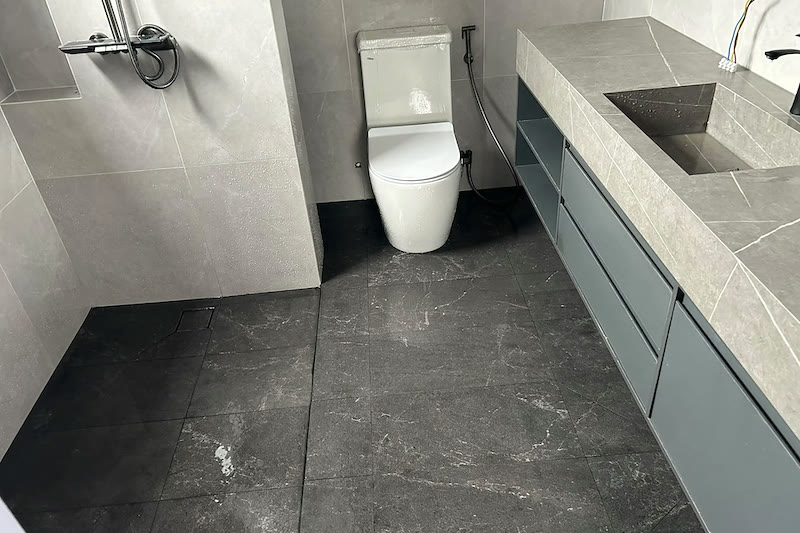
Pictured above: a bathroom on 37EW, one of our landed A&A jobs, from the update of 17 October. The WC and the vanity are fitted, the shower set is on the wall, and there is a floor drain at the shower. The tiles, the sanitary ware and the vanity are all things an owner may well have chosen and bought before the builder ever saw them.
Sooner or later in a landed A&A, the owner says it: "I'll buy the tiles myself", or "I've seen a basin I like, can I order it?" It is a reasonable thing to want. You choose the look, you shop around, and you may well save money. It is also one of the quietest ways for a job to slip, because the moment you order something yourself, three things that used to be the builder's problem become yours as well: when it arrives, whether it fits, and who pays if it is wrong.
This post is about that decision. Not which tile to buy, but what to settle with your builder before you place the order, so that the thing you bought arrives on the right day, fits what has already been built, and does not turn into an argument.
What we have seen on a real job
On 37EW, a three-storey semi-detached house, the updates on our live jobs page record the owner's own purchase arriving. On 29 September: "customer-ordered sanitary ware delivered and inspected on site before install", on the same day the window openings were wrapped ahead of the vinyl flooring. By 3 September the toilets and shower sets were already installed in both bathrooms, and on 17 October the update records the bathroom fitted out with its vanity and sanitary ware and the marble-look tiling and skirting in, in the final stretch before handover.
Two things are worth taking from that. First, the sanitary ware that a customer ordered was checked on site before anything was fixed. Second, the whole bathroom was a sequence: the floor and wall tiling, then the sanitary ware and fittings, then the painting and protection, over several weeks. An item you order yourself has to arrive at the right point in that sequence, not at the point when your shop happens to deliver it.
Buy it yourself, or let the builder supply it?
Neither is wrong. What matters is that your quotation says which it is, item by item. Many quotations carry an allowance for tiles and sanitary ware, a prime cost sum, which is the builder's estimate for something you have not yet chosen. We explain how those work, and where owners get caught, in provisional sums and PC sums in a landed build quotation.
If you decide to buy an item yourself, ask these before you order:
- Is that item coming out of the quotation? If the builder had allowed a sum for it, ask for the allowance to be taken out in writing, and what the figure is. An owner who buys the tiles and also leaves the allowance in has paid twice.
- Who is responsible for the installation, and is that still the same price? Fixing a basin you bought is the same work as fixing one the builder bought, but ask the question in writing so that nobody is surprised later.
- What if it is faulty? A product that is faulty when it arrives is usually a matter between you and your supplier. A product that is installed wrongly is usually a matter between you and your builder. What happens to a product that turns out to be faulty after it has been fixed to the wall? Who pays to take it out and put the replacement in? Settle that before the order, because after the event nobody has the same answer.
Contracts differ, and so do suppliers' terms, so we do not give a one-size answer. The point is that it is written down before the item is bought.
Before you pay the deposit: does it fit what has been built?
This is the check people skip. A basin, a WC or a shower mixer is not a free-standing object. It connects to a waste pipe, a water supply and a position on a finished wall or floor, and those positions are set while the walls are still open, well before the tiler arrives. So before you pay for anything:
- Get the installation sheet for the product, the one that shows where the pipes must come out and how far from the wall. Give it to the person managing your job and ask for written confirmation that the pipework positions on site match it. If the products are chosen after the pipes are in, ask whether the positions can still be adjusted, and at whose cost.
- Ask whether anything has to go inside the wall. Some fittings need a frame, a box or a concealed valve built into the wall before it is tiled. That is the moment to decide, because once the wall is tiled the only way to change it is to break the wall. The same logic is in our post on rewiring a landed house before the walls close: if it goes behind a finished surface, it is decided before the surface goes up.
- Check the floor. A floor drain or a shower floor needs its fall built into the bed under the tile. Where the floor has to slope towards a drain, the tile and the drain you choose have to suit that slope. We go through the falls in large-format floor tiles on a landed A&A.
Buying tiles yourself: four things that catch people
- Thickness changes the floor height. A thicker tile than the one the floor was prepared for raises the finished level at doors, landings and where the tiled floor meets another floor. Fix the tile before the floor levels are set, and tell the builder the thickness, not just the size and colour.
- Order enough, from one batch. Cut tiles waste material, and a tile broken in the last week cannot always be matched to what is already down. Ask the builder how many boxes they would order for each area, and agree who keeps the spare box after the job.
- Weight and delivery. Boxes of large tiles are heavy. Agree who unloads, where the stack goes, and that it is not left on a freshly screeded floor.
- The adhesive and the waterproofing are not part of the tile. Ask who supplies them and who decides they are suitable for the tile you chose. A tile bought on the strength of a showroom sample may need a different bed from the one the tiler was planning.
The day it arrives
This is the rule we saw on 37EW, and it is worth copying: inspect it on delivery, before it is installed. Once a basin is fixed to a wall or a floor is laid, "this is chipped" or "this is the wrong one" is an argument about who did it. Before installation it is a fact on a delivery note.
- Agree who receives it. A named person, on a known day, rather than a box left at the gate.
- Check it that day. Right model, size, colour and finish; every piece there, with its fixings; no chips, cracks or scratches; the box and the delivery note kept and photographed, with the date showing.
- Decide where it is stored. A box left in a room where painters and carpenters are working is a box that can be damaged. Ask for a dry spot, off the floor, in a room that is not going to be worked in.
Who looks after items between delivery and installation, and who pays if one is marked, is covered in who is responsible for scratched floors and chipped fittings, and the inspection list is in the finishing stage of a landed A&A.
Working out the date it has to be on site
The order date is counted backwards from the install date, not forwards from the day you felt like buying. For each item, ask the person managing the job for two dates: the day the trade that fits it will be ready, and therefore the day it has to be on site. Then ask your supplier for the delivery lead time in writing. If the second date is later than the first, the trade waits and so does everything behind it. This is why the quiet weeks in a finishing stage are often lead times, as in the record from 37EW, where the long wait on 29 August was carpentry and windows.
Questions to ask before you place the order
- Is this item in the quotation as an allowance, and will the allowance come out?
- Who fixes it, and is there any change to the price for fixing something I bought?
- Does the installation sheet match the pipework and the wall as they are now?
- Does it need anything built into the wall or floor first, and when is that done?
- What is the tile thickness, and have the floor levels allowed for it?
- On what date does it have to be on site, and what is the supplier's delivery time?
- Who receives it, who inspects it, and where is it kept?
- If it is faulty after it has been fixed, who pays to take it out and put the replacement in?
The short version
- Say in the quotation which items you will buy, and take their allowances out in writing.
- Check the product's installation sheet against the pipework and the wall before paying a deposit.
- Tell the builder the tile thickness, and order enough from one batch.
- Inspect every delivery the day it arrives, before anything is fixed, and keep it somewhere the other trades will not damage it.
- Count back from the install date to find the day it has to be on site.
- Agree who pays if a faulty item has to come out after it is in.
If you are planning the finishing stage of a landed A&A, see our A&A works page for how the work is staged.
If you are about to order your own tiles or sanitary ware for a landed A&A and want to check it against the job before you pay, WhatsApp us on 9107 2601. Tell us the house and where the job is up to, and we will tell you what to look at first. Wong Lye Pte Ltd holds a BCA General Builder Class 2 (GB2) licence.