
One-Day Solar Install on a Tiled Landed Roof: What to Have Ready Before the Crew Arrives
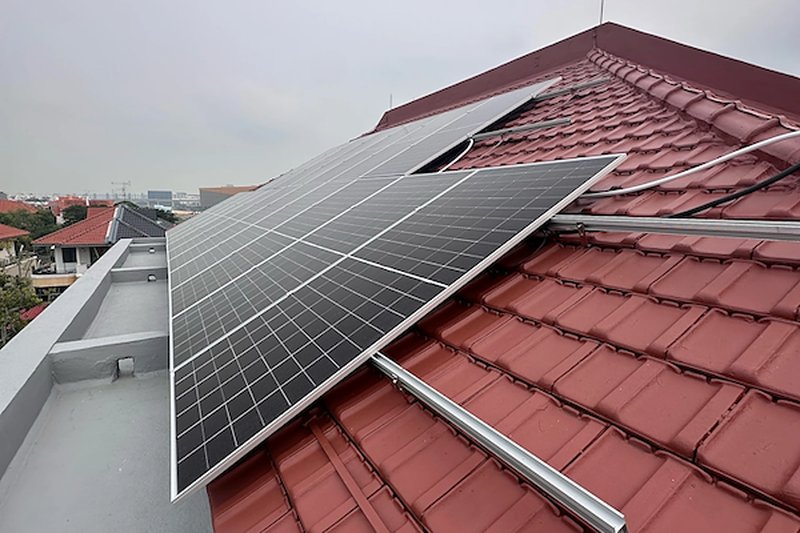
Pictured above: solar panels being laid on rails across the clay-tiled roof of our landed job 39EW, with cables already run along the tiles. The site update on our Live Jobs page, dated 21 October, reads "Solar PV System installed in 1 day."
That caption invites a question from every homeowner who reads it. If the panels went on in a day at one house, why does a quotation for yours say two to five days? And what can you do so that yours is closer to the one than the other?
We are not going to pretend a single job proves a rule. Our solar process page says the physical installation on a typical landed home takes 2 to 5 days, and that is the figure to plan around. One job finished in a day. What we can do is tell you what the day depends on, because almost all of it is settled before the crew arrives, and most of it is settled by questions you can ask and photographs you can take.
The day on the roof is the short part
On a tiled landed roof, the panels are the visible part and the smallest part of the job. By the time a panel is lifted, several things have already happened or have not. The roof has been looked at. The cable route has been decided. Somebody has confirmed how the crew and the panels reach the roof. The electrical side has been checked. The grid application has been filed. If any one of those is still open on the morning, the crew is not installing, it is waiting or deciding, and that is where a one-day job turns into a five-day one.
On our solar process page the order is set out in seven steps, and only the sixth is the installation. Five of the other six happen before it. That ratio is the whole point of this article.
What decides how long the roof work takes
These are the questions we would settle before a crew is booked. None of them is exotic, and none needs a price in it.
- How does anyone get onto the roof? Our near-final quote step confirms access and scaffolding from your photos. A roof reached by a fixed ladder or a roof hatch is a different morning from a roof that needs scaffolding put up first. If scaffolding is needed, that is extra work that has to happen before panels can go up, so ask when it is booked.
- What is already on the roof? Water tanks, a solar water heater, aircon condensers, old aerials. Anything in the way has to be moved, or the layout has to go around it. We ask you to photograph the roof from all sides, including anything sitting on it, for this reason. Our note on whether a landed roof is ready for solar covers the same list from the structure's side.
- What are the tiles like? On the roof in the photo, the rails run across clay tiles and the panels sit on the rails. Fixing rails to a tiled roof means working through the tiles, and every tile that is lifted has to go back so that the roof still sheds water. A tile that was already cracked, or that cracks underfoot, is a leak waiting for a heavy storm. We reinstate the roof waterproofing as part of the installation, and you should ask any installer whether they do, and who pays if a stain appears later.
- Can the roof carry it? Each 650W bifacial panel weighs about 33 kg plus its mounting rails, and a 20-panel system adds roughly 700 to 900 kg spread across the roof. Reinforced-concrete roofs from the 1990s onward are usually fine. Older clay-tile or lightweight metal roofs may need structural review by a Professional Engineer, which is a BCA requirement. That has to be done before the panels, not found out on the day.
- Where does the cable go? You can see it in the photo, running along the tiles. The cable route down from the roof to the inverter and the distribution board is decided at the site visit, and a route that is only worked out on the morning costs time.
- Is the distribution board ready? This is the item people forget, because it is not on the roof. Our quote step confirms whether your supply is single-phase or three-phase from a photo of your DB box with the door open. If the board has no room, or needs work, that is electrical work that comes before the crew, not during it.
The five photographs that save the most time
Our process starts with five phone photographs, and they are there because each one answers a question that would otherwise cost a day on site:
- Your DB box with the door open - for the electrical side, single or three-phase.
- Your SP meter - to see whether you already have an AMI smart meter or whether a swap has to be arranged.
- Your latest SP bill - the page with the 6-month usage chart. The SP account holder's name also has to match the grid application.
- The roof from all sides - including anything sitting on it.
- How you reach the roof - ladder, hatch, stairs or none.
Add three quick answers: the age and material of the roof, any past leaks, and whether anyone is home using aircon in the daytime. With those in hand, our site visit confirms the quote rather than starting from zero. That is the difference between a visit that takes an hour and a visit that ends with "we need to come back."
What stays outside the installation day
A day or a week on the roof is not the whole timeline, and it is worth knowing the rest so that nobody tells you the system is "done" when it is not switched on. From a signed quotation, our published landed-home timeline is typically 4 to 8 weeks. Paperwork and approvals run in parallel with ordering the equipment, which takes 2 to 4 weeks. The physical installation then takes 2 to 5 days. SP Group's meter work and turn-on follow after that. So a one-day install does not mean the panels are generating on day two.
The paperwork is the part most owners never see. The grid-connection application to SP Group is made by a Licensed Electrical Worker, and the system is registered for export credit under the Simplified Credit Treatment. We make those applications. What we need from you is your SP bill, because the name on it has to match. Our article on EMA and grid approval for landed solar explains what each approval is for.
What you can ask a solar crew before the day
- How many days do you expect on the roof, and what would make it more?
- Is scaffolding needed, who puts it up and when?
- Are the rails fixed through the tiles, and how do you put every lifted tile back so the roof still sheds water?
- Who is responsible if a tile cracks, or if a stain appears in a ceiling after the next heavy rain?
- Where will the cable run from the roof to the inverter and the board, and is any of it on the outside of a wall?
- Has anyone checked the roof structure, and if it needs strengthening, is that inside the quotation or somebody else's job?
- Will someone from your side be on site each day? On our jobs we ask the owner to be home for the site visit and the installation days.
A vendor who can answer all seven without hesitation has done the preparation. One who answers "depends on the day" for most of them is promising a quick install and leaving the open questions to the morning.
The honest limit of one job
The 39EW update is a real record of one job on one roof, and it is a good reason to ask about speed. It is not a promise that your roof will take a day. Roof type, access, the existing equipment on it, the structure beneath it and the state of the electrical board all change the answer, and the weather can move a roof day, as it moves any outdoor work in Singapore. What the one-day figure does show is that a well-prepared tiled roof can be done quickly. The preparation is the part you control.
Next step
If you are weighing solar for a landed house, start with our solar process page, which lists the seven steps and what we handle at each. Use the solar calculator for a first view of your numbers; our note on what the calculator number cannot see explains what the site visit adds. Or WhatsApp us the five photographs and the three answers and we will tell you what we would settle first. The near-final quote comes from your photos and the site visit confirms it. Our solar page sets out how we assess the roof before we quote.