
A Marble-Look Feature Wall in a Landed House: What the Wall Behind It Must Be Before the Panels Go Up
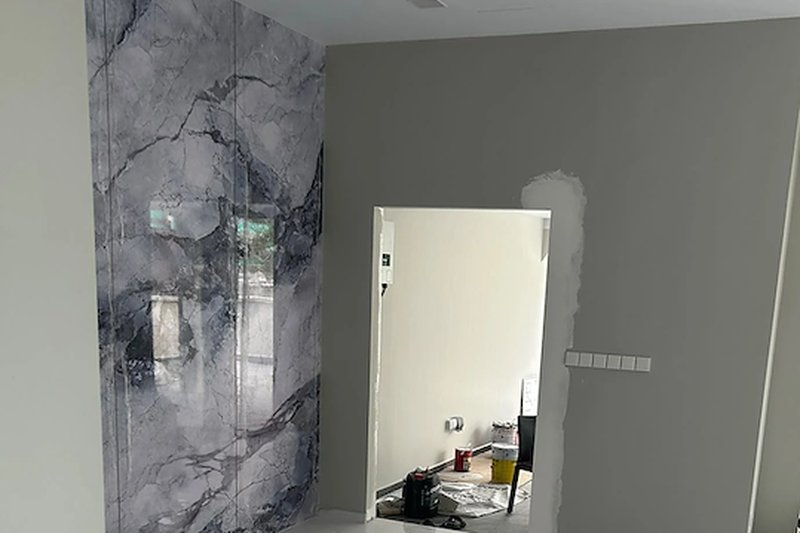
Pictured above: the marble-look feature wall on one of our landed A&A jobs, 37EW, as posted in our site update of 23 October. The panels stand beside a plain painted wall, with the doorway to the next room next to them. A thin vertical line shows where two panels meet, and the glossy face picks up reflections from the room.
A feature wall is the part of a landed house that visitors notice first and the part owners remember paying for. It is usually a large marble-look panel or slab wall behind the sofa, the dining table or the television, and it is chosen from a sample the size of a coaster. What decides whether it looks right on the day is not the sample. It is the wall the panels are fixed to, the points that were cut or left out before they went up, and where the joints fall.
This article is about those three things. It is for an owner partway through a landed A&A who has chosen a feature wall, or is about to, and wants to know what to ask the builder before anything is ordered. On 37EW our site update of 22 October still listed floor tiling and painting as in progress, and the update of 23 October listed the floor tiling and the marble-look feature wall as done, with ceiling lights fitted along the side passage.
Start with the wall behind it
Large panels are stiff and heavy, and they do not follow a wall the way paint does. Paint hides a slightly wavy wall. A panel with a glossy face shows every wave in its reflection. So before panels are ordered, ask what the wall behind is and what condition it must be in.
- What is the wall made of? A brick or block wall, a new concrete wall and a lightweight partition are three different jobs. If the wall is a partition, ask what will carry the weight of the panels and who has checked it. On a structural or party wall, nothing should be cut or fixed into it without the engineer's agreement.
- Is it flat and upright? Ask to see a long straightedge or a level held against it before the panels are fixed, and ask what happens if it is out. A wall that is corrected now costs a little. The same wall found out of line after a panel is up costs the panel.
- Is it dry? If the other side of the wall is a bathroom, a planter, the outside face of the house or a roof terrace, damp can reach it. A panel does not cure a wet wall. Settle the waterproofing first; where it tends to fail is covered in where waterproofing fails on a landed home.
- Is it finished? Plaster cured, dust and loose paint gone, nothing still to be chased or patched. The photo shows a patched strip of wall beside the doorway, the kind of repair that should be finished before a panel goes near it.
Settle every point on the wall before it is covered
A panel cannot be cut once it is up without risk to the panel, so every switch, socket, data point, light and bracket that will sit on or beside the feature wall has to be marked first. If the television is going on this wall, decide the height and the position of the bracket, the power point and the cable route before the electrician closes the wall. If a switch plate sits beside the panels, as it does in the photo on the plain wall next to the doorway, its height and its distance from the panel edge should be agreed on the drawing rather than found on the day.
The sequence for electrical work is the same one set out in rewiring a landed house: decide before the walls close: cables in before the wall is covered, positions marked before the panels are cut. Ask for the points to be shown on a wall elevation, and tick them off against the wall before anything is fixed.
Where the seams fall
A wall wider than one panel has seams. The thin vertical line in the photo is where two panels meet. You cannot avoid seams on a large wall, but you can decide where they go and how the veining runs across them.
- Ask for a set-out drawing. It shows the panel layout on the wall, where each joint lands, where the cut-outs are, and which panel is cut at the ends. A seam that lands in the middle of a television, or a thin offcut at a corner, is a layout problem and can be seen on paper.
- Ask for the panels to be laid out dry and photographed before they are fixed, so you can see how the veining flows from one to the next. After they are fixed, a mismatch is a replacement.
- Ask whether all the panels come from the same batch. Colour and pattern can differ between batches of the same product, and a replacement panel ordered later may not match.
- Ask for spares. Cut-outs and offcuts take material, and a cracked panel on delivery should not hold the job up while another is ordered. Ask who orders them, who stores them and who pays if one is damaged.
The edges decide how it looks from across the room
The edge details are small and they show. Settle these on the drawing:
- The bottom edge. Does the panel run to the floor, stop at a skirting, or sit on a plinth? On 37EW the floor was laid with marble-look tiles, and the panels meet it at the bottom. Whichever comes first, agree how the joint is finished and whether a gap is left and filled.
- The top edge. Panels meeting a ceiling need an agreed finish at the junction, and any air-conditioning or light fitting near it needs to be located before the panels are cut.
- The side edges and corners. Where the panels end against a plain painted wall, as in the photo, ask how the end is finished and who paints the plain wall next to it, so the painter is not working against a finished glossy face.
A glossy face shows everything
Every ripple, joint offset and bit of adhesive shows in a glossy surface, in the same way that a glossy floor shows its lumps; our post on large-format floor tiles explains why a big hard face needs a prepared base. Look at the wall at handover from a low angle with the light behind you, and from across the room, and write down anything you see on the defects list. The room-by-room method is in taking handover of a landed build.
Order of work and who protects it
The feature wall sits late in the sequence, after the wet trades and next to the paint and the floor, which is the order described in the finishing stage of a landed A&A. That means the panels are fixed into a room that is nearly finished, and a glossy face scratches. Ask who covers the panels once they are up, what is used, and who is responsible if a painter, a carpenter or a delivery marks them. The principle is covered in who is responsible for damage between trades.
Also ask for the delivery date of the panels and what the programme does if they are late. The panels are ordered long before they are fixed, and a feature wall that is not on site when the carpenter and painter are ready holds up the trades that follow.
What tends to go wrong
- The wall behind is out of line and nobody checked it before the panels were fixed.
- A socket or switch is missing or in the wrong place, and the panel is cut after fixing.
- A seam lands in a bad place because nobody drew the layout.
- The panels do not match because a replacement came from another batch.
- The bottom or top edge is left undecided and is finished on the day with whatever is to hand.
- The glossy face is marked by the trades that follow, with no one named for protecting it.
Questions to ask before the panels are ordered
- What is the wall behind, and has anyone checked that it can carry the panels?
- Is it flat, upright and dry, and what is done if it is not?
- Where are the switches, sockets, television and lights on this wall, and are they on an elevation?
- Can I see a set-out drawing with the seams and the cut-outs?
- Will the panels be laid out dry for me to see before they are fixed?
- Are all the panels from one batch, and are there spares?
- How are the bottom, top and side edges finished?
- Who covers the panels once they are up, and who pays if one is marked?
The short version
- A feature wall is decided by the wall behind it. Ask whether it is sound, flat, upright and dry before anything is ordered.
- Mark every switch, socket and light before the wall is covered. A panel cannot be cut safely once it is up.
- Ask for a set-out drawing, a dry lay-out, one batch and spares.
- Settle the edges and who protects the glossy face in writing.
If you are planning the last stages of a landed A&A, see our A&A works page for how the work is staged.
If you are planning a feature wall in a landed house and want to check the wall, the layout and the points before the panels are ordered, WhatsApp us on 9107 2601. Tell us the house and where the job is up to, and we will tell you what to look at first. Wong Lye Pte Ltd holds a BCA General Builder Class 2 (GB2) licence.