
Interior Painting on a Landed A&A in Singapore: What the Wall Must Be Before the First Coat, and How to Check It Before the Last
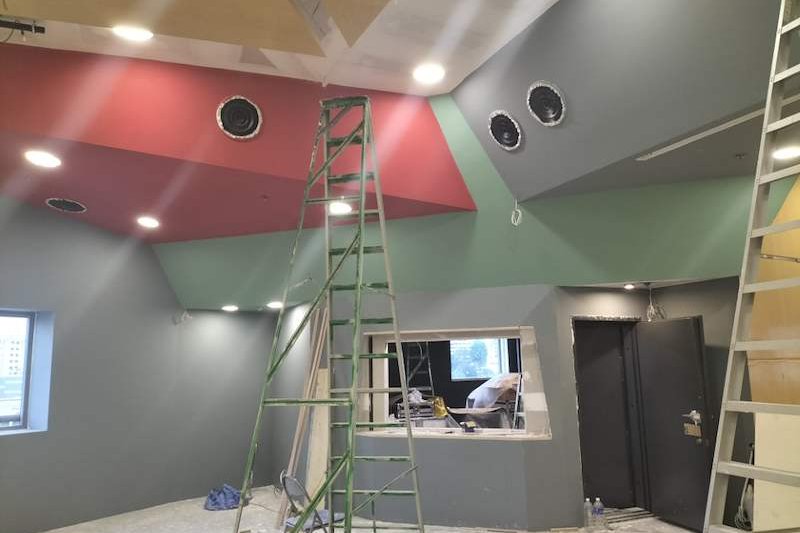
Pictured above: the painting stage of a music studio fit-out in our project archive (Studio), for illustration. Walls and ceilings are coated in the room's colours, ladders are still standing and the floor is bare. A landed house looks different, but the order is the same: the paint goes on after the wall work is finished, and it goes on before the floor and the fittings are.
On a landed A&A, painting is the trade owners pay least attention to until the day it is done. The colour is chosen, the painters come, and a few days later the walls are white or grey or whatever was agreed. Then the owner walks through with the lights on and sees every ripple in the plaster, every patch where an electrician opened the wall, and every hairline running out of a corner. By then the paint is on, and the argument about whose fault it is has no good answer.
The paint is not the hard part. A painted wall shows what is under it, and a coat of paint is the first time the owner sees the wall in a single colour, in light, from the end of the room. This article is about what the wall must be before the first coat goes on, and how to look at it before the last coat is applied, while it can still be put right cheaply. It is about interior walls and ceilings. Painting the outside of the house, with its own questions about cracks, damp and the scaffold, is covered in repainting the outside of a landed house.
Where painting sits in the job
On a real job of ours, 37EW, a three-storey semi-detached A&A, the walls were plastered and the bathroom tiling was going in at the end of July. Painting started on 29 August with the ceilings inside and the external walls. Interior painting followed on 15 September, with the staircase walls coated, the handrail and balustrade wrapped and taped, and the toilet tiled, with the WC in and covered while the painting went on. The carpentry came in on 17 and 22 September, and the vinyl floor was delivered on 1 October. That sequence is in our post on the finishing stage of a landed A&A.
Two things follow from that order. Painting comes after the wet trades, plaster, tiling and screed, because those are the trades that splash and drip. And painting comes before the floor and the carpentry, because paint drips and a roller does not respect a finished floor. So there is a stretch of weeks in which the walls are bare, then primed, then painted, and everything the owner is going to ask about the wall has to be settled in the first part of it.
What the wall must be before the first coat
A painter can fill, sand and prime, and a good one will say when a wall is not ready. But he is paid to paint the wall in front of him, and a wall that is wet, cracked or dusty will be painted if nobody stops the job. The checks below belong to whoever manages the job, and the owner can ask to see each one.
- Dry. New plaster holds water, and paint over damp plaster blisters, peels or goes patchy. Ask how the builder decides a wall is dry enough to paint, and do not accept "it looks dry". Rain on an exposed wall in the days before is a reason to wait. Our post on wet weather on a landed build lists what needs a dry surface.
- No leaks behind it. A stain on a wall or a ceiling is information, not a cosmetic problem. If a leak has marked it, find the source before anything is painted over, because a stain painted over will come back through the new coat. Where it comes from is covered in where waterproofing fails on a landed home.
- Patched and left to set. Every place where the electrician chased a cable into the wall, the plumber opened it, or a frame was fixed has been made good. Those patches show through paint if they are rushed or if the surface was not prepared. Walls should be finished with cables, boxes and pipes already in, which is the point of getting the services done before the walls close.
- Flat enough. Plaster is rarely perfect. What matters is whether the wall is flat enough for the finish you want: a plain matt wall hides a lot, a glossy or dark colour hides nothing, and a strong light along a wall shows everything. If you have chosen a dark colour or a sheen, say so before the plastering is signed off, not after.
- Frames, boxes and edges in place. Door frames, window frames, switch boxes and trims that will touch the wall are fixed before painting, so the paint meets them with a clean line. A frame fitted afterwards leaves a gap that has to be caulked and painted again.
- Steel and metal protected. A staircase, a handrail or a balustrade is covered with tape and sheeting before the walls are coated, as it was on 37EW. Bare metal should have its own coating system, agreed separately, so ask who coats it and who touches it up at the end.
Agree the colour on the wall, not on the card
A paint chip tells you little about a room. The same colour looks different on a north wall and a west wall, in daylight and under the lights that will be fitted later. Ask for a patch to be painted on the actual wall, large enough to stand back from, and look at it morning and evening before you approve the colour. Then write down the product, the colour name or code and the finish for each room. That is the record that settles a dispute later, and it belongs in the quotation, not in a message thread. If you change your mind after the walls are painted, that is a variation and a repaint, and variation orders on a landed build explains how to keep it on paper.
Ask also what is being priced. A quotation that says "painting to all walls and ceilings" does not tell you the paint, the preparation or the number of coats. The same specification words can mean different work, so ask for the preparation and the number of coats to be written in.
How to look at a wall before the final coat
The best time to inspect paint is before the last coat, when a flaw is a sanding job and not a repaint. Ask the painter or the site supervisor to tell you when the walls have had their preparation and first coat, and walk through with them.
- Use a raking light. A torch held flat against the wall, shining along it, shows ripples, patches, sanding marks and roller lines that ordinary light hides. This is how a painter checks his own work, and it is how you should check it too.
- Look at it in daylight and with the lights on. A wall that looks even at midday can look patchy under a downlight. Check both, standing at the far end of the room as well as close up.
- Mark what you find, do not point. Use a small piece of low-tack masking tape beside each flaw. It tells the painter exactly where to go, and you can count the marks at the next visit.
- Check the edges. The line where wall meets ceiling, where paint meets a frame, and the corners. Crooked lines, brush marks and paint on hinges, handles or glass are the things people notice first.
- Check behind the door and under the window. Those are the spots that were not painted properly because nobody looks there, until the owner moves in.
- Look at the old-to-new line. On an A&A, the place where a new wall meets an old one is where cracks open first. If a crack there has simply been filled and painted over, it will come back. Ask what was done at that junction. Our room-by-room handover inspection explains why it is the most informative line in the building.
The last coat is not the last visit
After the painters finish, the carpenters, the electricians fitting lights and the flooring installers come through the same rooms. Walls get scuffed, corners get chipped and a ladder leaves a mark. That is not carelessness on one person's part, it is what happens when several trades work in a finished room. Who looks after the covers and who pays for a chip is discussed in who is responsible for scratched floors and chipped fittings.
So ask for a touch-up visit to be planned for after the last trade has left and before the handover walk-through, rather than expecting the wall to be perfect on the day the painters pack up. Keep the leftover paint, labelled with its colour and room, because a touch-up with a different batch can show.
Questions to ask before painting starts
- How will you decide the walls are dry and ready, and who signs that off?
- Is every patch, box and frame finished before the first coat?
- What is the paint, the colour code and the finish for each room, and where is it written down?
- Can a sample patch be painted on the actual wall for approval?
- Are the staircase, handrails and metalwork covered, and who coats and touches up the bare metal?
- When can I walk through after preparation and the first coat, before the final one?
- When is the touch-up visit planned relative to the carpenters, lights and flooring?
- What is done at the junction between old and new walls, so a crack does not simply come back?
- Who keeps the leftover paint, and is it labelled?
The short version
- Paint shows the wall. Settle dryness, leaks, patches and flatness before the first coat.
- Agree the colour on the real wall and write down the product, code and finish for every room.
- Inspect with a torch along the wall, in daylight and under the lights, before the last coat.
- Plan a touch-up visit after the last trade, and keep labelled leftover paint.
If you are planning the finishing stage of a landed A&A, see our A&A works page for how the work is staged.
If you are partway through an A&A and want to know what to check before the painters start, WhatsApp us on 9107 2601. Tell us the house and where the job is up to, and we will tell you what to look at first. Wong Lye Pte Ltd holds a BCA General Builder Class 2 (GB2) licence.