
Insurance on a Landed A&A or Rebuild: What Covers an Injured Worker, a Neighbour's Damaged Wall and Your Own House
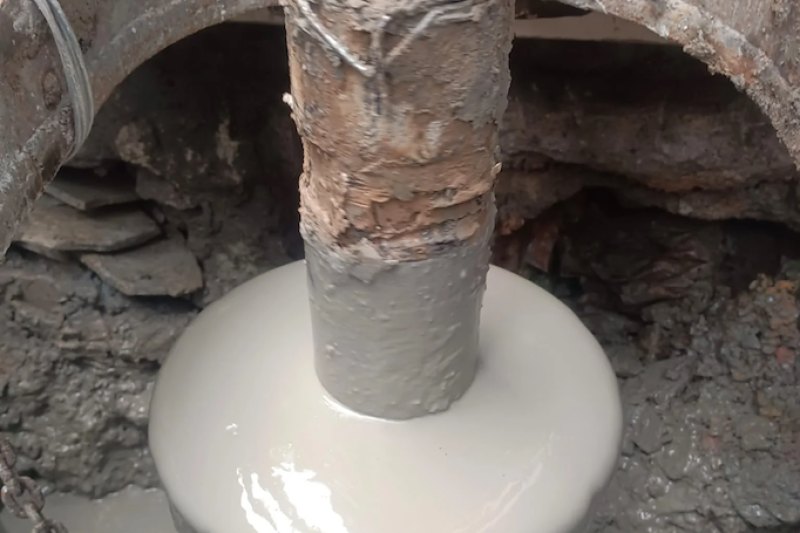
Pictured above: the casing at a pile position during drilling, on one of our landed rebuilds. Heavy ground work is the stage of a rebuild where an injured worker, a shaken boundary wall or a damaged drain is most likely to turn from a worry into a claim, which is why the cover behind it should be settled before this day, not after it.
Owners usually ask about insurance once, quickly, at the end of a meeting: "You are insured, right?" The answer is almost always yes, and almost nobody asks the follow-up. But "insured" is not one thing. On a landed A&A or rebuild there are three separate things that can go wrong, and each is covered by a different policy, held by a different person.
This piece separates them: who is covered if a worker is hurt, who is covered if a neighbour's property or a passer-by is harmed, and what protects your own house. It is plain information to help you ask better questions, not insurance advice; the wording of a policy is the only thing that decides what it covers, and the people who can read it for you are the insurer and your own adviser.
Question one: if a worker is hurt, whose policy pays?
On a landed site there are usually more workers than the builder's name suggests. Some are the builder's own employees. Many are employed by subcontractors: the piling team, the electrician, the tiler, the metal installer.
Work injury compensation insurance is an employer's duty, and the Ministry of Manpower is specific about it. On its page on work injury compensation insurance, MOM says an employer must insure all employees doing manual work, whatever their salary, and non-manual employees earning $2,600 or less a month. Failing to provide adequate insurance is an offence, with a fine of up to $10,000 or jail of up to 12 months, or both. Policies from 1 January 2021 must be issued by a designated insurer.
The part owners tend to miss is who holds the policy. MOM's page says that project-wide work injury policies are no longer to be taken out as new policies (from 1 September 2020), and that each employer, including each subcontractor, must buy insurance for its own employees. So on your site the cover for the piling crew is the piling company's policy, not the builder's, and not yours.
That is not a reason to worry; it is a reason to ask one question in writing: who employs the people who will be on my site, and does each employer hold its own work injury compensation insurance? A builder who works with the same subcontractors on every job will answer it in a line.
Question two: if someone else's person or property is harmed
This is what owners are usually picturing when they ask about insurance: a neighbour's wall cracks, a pipe is hit, a piece of debris lands on a parked car, a visitor trips on the hoarding line. This is the territory of public liability insurance, which in general responds to injury or damage suffered by third parties because of the works.
Wong Lye publishes one position on this: public liability insurance is in force for the whole of your project while works are running. We do not describe it as more than that. It is cover for third parties. It is not the warranty, which is a separate commitment that starts at handover and is covered in what your warranty after handover covers and does not cover.
Whoever your builder is, these are the questions that turn "yes, we are insured" into something you can rely on:
- Whose name is on the policy? The builder's company, not an individual or an unrelated firm.
- What dates does it run? It should cover the start of work through completion. Ask what happens if the programme runs past the end date on the certificate.
- What is the limit, and what is the excess? Ask for the figures as written on the policy schedule, not as a verbal answer.
- Are there exclusions that touch your job? A rebuild involves demolition, piling and excavation next to boundaries, so ask directly whether any exclusion relates to vibration, to underground services, or to work close to adjoining houses.
- Can you see the certificate and the wording? A certificate says a policy exists; the wording says what it does.
We would rather you asked these of any builder before signing than found out the answers afterwards. If we are the builder, ask us in the same way.
Question three: what protects your own house?
This is the one that is least often asked and most often assumed. A public liability policy is about harm to other people. It is not insurance on your own home. The house you are altering, the contents inside it and, where you are rebuilding, the new structure as it goes up, are your concern first, and the one to ask is your own insurer.
Before work starts, tell your own insurer in writing what is planned: an A&A, a partial demolition, a full rebuild. Ask three things:
- Does the policy on the existing house continue while building works are under way, or does it need to be changed?
- Are there conditions about structural alteration, or about the house being unoccupied if you move out during the works?
- What happens to contents, and to anything you have bought for the new house (fittings, sanitary ware, appliances) while it sits on site before handover?
Insurers differ and policies differ, so we do not guess the answers. Asking in writing, before the first day, gives you a reply you can file. Asking after something has happened gives you a conversation about whether you should have asked.
Evidence is what makes any of this work
Every one of the three policies above turns on the same practical thing: being able to show what the condition was before, and what happened after. That is why we keep returning to records.
- The condition of neighbouring houses before work starts. A dilapidation survey records existing cracks and stains with dates and photographs. It protects the neighbour, and it protects you, because the most common dispute is over damage that was already there.
- Your own house. Photograph each room, the ceilings, the boundary walls and the drains before demolition begins, and keep the files somewhere that is not on the site.
- An incident, if one happens. Tell the builder in writing the same day. Say what, where and when, attach photographs, and keep the message. Do not wait for the next site meeting.
Prevention matters more than any claim, which is why the demolition sequence, debris control and protection at the boundary belong in the scope; we set that out in protecting neighbours during demolition and rebuild.
What to ask your builder, in one list
- Who employs each trade that will be on my site, and does each employer hold its own work injury compensation insurance?
- Can I see the public liability certificate and the policy wording, with the dates, the limit and the excess?
- Does any exclusion apply to demolition, piling, excavation or vibration near adjoining houses?
- If the programme runs late, does the cover continue, and who tells me if it lapses?
- Who arranges the before-work records of the neighbours' houses, and who keeps them?
- What do you need from me, and from my own insurer, before the first day?
The short version
- "Insured" covers three different questions: a worker hurt, a third party harmed, and your own house.
- Work injury cover belongs to each employer, subcontractors included, so ask who employs the people on your site.
- Public liability is cover for third parties and is not the same as a warranty or as insurance on your own house.
- Ask for the certificate and the wording, not just a yes.
- Tell your own insurer before work starts, and get the reply in writing.
- Keep before-work records of your house and the neighbours' houses; every claim turns on them.
If you are planning an A&A or a rebuild and want to go through what is in place before work starts, WhatsApp us on 9107 2601. Send us the house, the type of works and the stage you are at. Wong Lye Pte Ltd holds a BCA General Builder Class 2 (GB2) licence and builds on landed homes across Singapore. See how we run landed A&A works.