
The Finishing Stage of a Landed A&A: The Order the Trades Arrive In and the Lead Times That Hold You Up
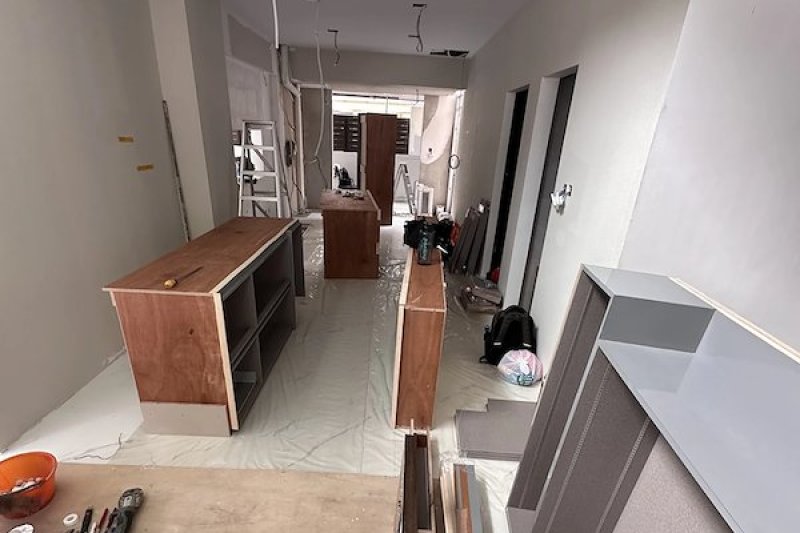
Somewhere past the three-quarter mark of a landed A&A, owners start asking the same thing. The structure is up, the walls are plastered, and the site seems to have gone quiet. A few days pass with one worker on site, or none. The question behind it is the one people actually type: what happens in the finishing stage of an A&A project, and why does it feel so slow?
We post dated updates from our own sites on our live jobs page, so instead of a textbook answer, here is the real last stretch of one job: 37EW, a three-storey semi-detached house. The notes below come from the updates we posted on that page, in order.
What the last stretch of one real job looked like
- 22 July. Window and door openings being formed and the wall smoothed around them. Floor tiles set out with levelling clips before grouting. Wiring still run loose while the rooms are being finished.
- 29 July. Walls plastered, bathroom tiling going in, the staircase balustrade set. The floor almost ready for screed.
- 18 August. Exterior flooring about 90% done. Inside, the self-levelling screed started, ready for vinyl flooring.
- 29 August. Painting started: the ceilings inside and the external walls, with the scaffold still up. The note that day said we were four months in and that the long wait now was carpentry and windows.
- 3 September. The sliding gate went up, its frame welded on site before it was fitted. Solar lifted to the roof by crane. Toilets and shower sets installed in both bathrooms.
- 15 September. Interior painting started. Staircase walls coated, with the handrail and balustrade wrapped and taped. In the toilet the tiling was done and the WC was in, covered while the painting went on.
- 17 and 22 September. Carpentry in. Cabinet carcasses and the island base on site and being fitted, with the floor still covered for protection.
- 29 September. Window openings wrapped in plastic sheeting ahead of the vinyl flooring that weekend. Customer-ordered sanitary ware delivered and inspected on site before it was installed.
- 1 October. Vinyl flooring delivered. The roof awning fully sealed with a triple layer so leakage does not happen.
Read that list as an owner and the "quiet" weeks make sense. Almost nothing in it is the builder waiting for nothing. It is a fixed sequence, and a few items in it arrive on somebody else's schedule.
Why the order is what it is
The finishing stage runs from wet and dusty work towards clean and delicate work, and each step protects the one before it.
Wet trades first. Plaster, tiling and screed are done while the rooms can still take water and mess. Painting follows once those are dry, ceilings and walls first because that is where the drips and overspray fall.
The floor goes down late on purpose. On this job the self-levelling screed started on 18 August. The vinyl was delivered on 1 October, about six weeks later. In between, the painters, the gate welders and the carpenters all worked in those rooms. A floor that is ready early is not a floor that should be laid early; it gets covered, and the covering is the visible sign that the sequence is being kept. The photo on this post is that stage: cabinet carcasses and an island base being fitted, with sheeting over the floor.
Openings are protected until the last dirty job is done. The window openings on 37EW were wrapped in plastic sheeting ahead of the flooring. A wrapped opening, a taped handrail and a covered WC all mean the same thing: that part of the house is finished enough to be worth protecting.
The weather sealing is part of this stage too. The 1 October note about sealing the roof awning with a triple layer landed in the same week as the flooring delivery, which is the right order. Ask to see any roof or external sealing done and checked before the interior floors go over the rooms below it. Our post on waterproofing failure points on landed homes covers where it goes wrong.
The quiet weeks are usually lead times
The record has its own explanation. On 29 August the update said the long wait now was carpentry and windows. Those are made to your design or your measurements somewhere else, and they cannot be fitted until the walls, ceilings and floor screed around them are ready. A builder cannot hurry a cabinet that has not been built.
The same goes for anything you chose yourself: sanitary ware, tiles, flooring, light fittings. Every one of them has an install date and a day it must be on site by, and the day it must be on site by is counted backwards from the install, not forwards from when you felt like ordering. This is the same date logic that sits behind allowances in a quotation, which we cover in provisional sums and PC sums in a landed build quotation.
The practical move is simple. Ask your builder for a short list: every item still to arrive, who is ordering it, and the date it has to be on site. Then hold yourself and your supplier to those dates.
Inspect when it arrives, not after it is installed
One line in the 29 September update is worth copying: the customer-ordered sanitary ware was delivered and inspected on site before install. That order matters. Once a basin is fixed to a wall or a floor is laid over a doubtful batch, "this is the wrong one" or "this is chipped" becomes an argument about who damaged it. Before install, it is a fact on a delivery note.
When something you ordered arrives, check it the same day, with whoever is receiving it:
- Is it the model, size, colour and finish on your order, not a near match?
- Is every piece there, with the fixings and the accessories that belong to it?
- Is there any chip, scratch or crack, on the item or its box, before it is unpacked?
- For flooring or tiles, is the quantity enough for the area, and do the boxes match each other?
Photograph it on the delivery. If something is wrong, you have a date, a photo and a supplier to call while the trade that needs it is still booked.
What to ask in the last third of the job
- Which items are still to arrive, who ordered each, and by what date must each be on site?
- For anything I am ordering myself, what does the builder need from me? Size, model, delivery date, and who will receive and inspect it.
- What is the order of the remaining trades, and which rooms are covered until when? Then plan your own site visits around it, and leave the covers on.
- When are the roof and external sealing checked, relative to the flooring?
- When is the handover walk-through, and what has to be ready for it? Our post on taking handover of a landed build sets out the room-by-room check.
One more habit belongs here. Changing your mind about a finish in this stage is the most common way a quiet programme becomes a late one, because the trade behind it is already booked. If you do change something, get the change and its date on paper first; variation orders on a landed build explains how that works.
The short version
The last stretch of an A&A is not slow because nothing is happening. It is a sequence of wet work, painting, carpentry and, last of all, flooring, with covers on everything already finished. The weeks that look empty are mostly made-to-order items arriving on their own schedule. The two things that are in your hands are knowing the date each item must be on site, and inspecting what you ordered the day it arrives.
Partway through a landed A&A and not sure what is still outstanding? WhatsApp us on 9107 2601 and tell us about your house and where the job is up to. Wong Lye Pte Ltd holds a BCA General Builder Class 2 (GB2) licence and builds A&A works, extensions and reconstructions on landed homes. See A&A works for landed homes.
Related reading: your role as owner during an A&A · A&A timeline, first call to handover · wet weather on a landed build
For the floor itself, what the screed has to be before large tiles go down, see large-format floor tiles on a landed A&A.
The staircase is one of the first pieces of metalwork to go in and sits among the other trades for weeks. See a floating staircase in your own landed house for who should protect it and who should touch up the coating at the end.
Finished rooms are covered because the next trade can mark them. Who looks after the covers, and who pays when something is still damaged, is in who is responsible for scratched floors and chipped fittings in the last weeks of a landed A&A.
Painting is the step in this sequence where the wall itself gets judged. What the wall must be before the first coat, and how to check it before the last, is in interior painting on a landed A&A.
The last door in the house is often the one under the stairs. What the space behind it needs before the door is made, including a vent, is in the door under the staircase of a landed house.
A feature wall of large panels sits in this sequence too: see what the wall behind it must be before the panels go up.
If you are ordering the sanitary ware or tiles yourself, what to settle with your builder before the order is placed is in buying your own tiles, sanitary ware and fittings for a landed A&A.
Related: the power for built-in cabinets is fixed after the carpentry arrives, so its positions have to be settled much earlier. See sockets and switches inside built-in cabinets on a landed A&A.
Vinyl is the floor most exposed to the trades that come after it. What the screed has to be before it goes down, and when to uncover it, is in vinyl flooring on a landed A&A.