
Car Porch and Side Passage Lighting on a Landed A&A in Singapore: Where the Lights and Wiring Go Before the Ceiling Is Painted
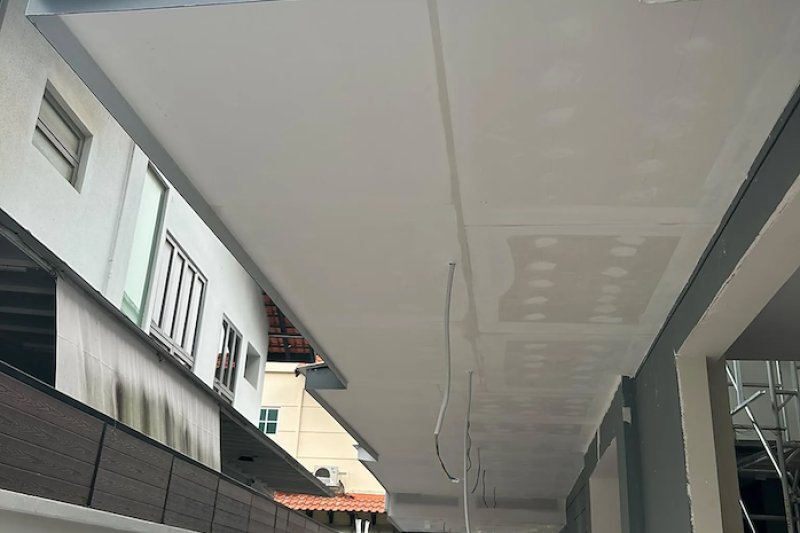
Pictured above: the car porch ceiling on our landed job 37EW once the boards were up. The joints and screw holes are filled, and the wiring is left hanging, ready for the lights. Our site update of 12 October on the Live Jobs page describes it as ready for sanding and paint.
Lights on the outside of a landed house get decided last and noticed first. Nobody studies the car porch ceiling in daytime. At night, a porch with one lamp in the wrong place, a side passage you cannot see down, or a gate pillar with nothing on it is the first thing you notice when you drive in.
The trouble is that the positions are not really decided last. They are decided on the day the ceiling boards close. Before that, the cable ends can come out of the ceiling anywhere. After it, moving a light means opening a board, patching, and painting again. This article is about that window, using what our own updates on 37EW show, and the questions to ask before it shuts.
What 37EW's updates show, in order
37EW is a three-storey semi-detached house we are finishing, and its outside lighting went in over about eleven days. We are using the dates from our own Live Jobs updates, so you can see the order rather than take our word for it.
- 12 October. Ceiling boards are up across the car porch and the side passage. The joints and screw holes are filled, and the wiring is left ready for the lights. The note says ready for sanding and paint.
- 14 October. The car porch soffit is painted. New floodlights are up on the eaves, and a gate pillar lamp is fitted at the front.
- 23 October. Ceiling lights are fitted along the side passage.
Read that as a sequence. The board went up first. The positions had to be known by then, because the wiring was left where each light would sit. The paint followed two days later. On the side passage, the fittings came last, nine days after the paint. That order is the one we would want on any job.
Why the positions have to be settled before the boards close
On a bare ceiling the cable can be brought to any spot. The ceiling gets drawn, set out and boarded, and the board is cut around where each cable comes through. Once the boards are up and the joints are filled, the ceiling is a finished surface. A light that needs to move even a short way is no longer a small change, because it means a new hole, a repair to the old one, and paint over both.
The cost does not come from the electrical side. It comes from undoing the work of the trades that came after. Fill, sand and paint are all done around the cable ends. A move after the paint means the painter comes back too. Our article on damage between trades covers the other half of this: a finished surface that is reopened is a surface somebody has to be responsible for.
The four places outside lights usually go
On a landed house the outside lighting is not one job, it is four. Each one has its own question to settle before the boards close or the wall is finished.
1. Under the car porch soffit
This is the ceiling in the photograph. Ask how many lights, where each one sits relative to the car doors and the front door, and what is above the board at each point. Where a light is meant to sit between two board joints rather than on one, say so before the boards are cut. A light placed on a joint or too close to the edge looks wrong once the ceiling is painted, and it cannot be moved without being seen.
2. Along the side passage
A side passage is long, narrow and usually dark. The 37EW passage ceiling was boarded in the same update as the car porch, and its lights were fitted nine days after the porch soffit was painted. Settle the spacing along the length, not only the first and last light, and ask where the switch for them will be and whether you can reach it from inside the house.
3. Floodlights on the eaves
On 37EW the floodlights went up on the eaves, not on the ceiling. A light on the outside of a wall has its cable on the outside of the wall, or in it, and that has to be decided before the wall is plastered and painted. Our article on rewiring a landed house makes the same point for the walls inside: conduits go in before the things that would have to be broken to install them.
4. The gate pillar lamp
The lamp is fitted last, but the cable to it is run long before, through the pillar. A pillar that is already built and plastered has no easy way to take a new cable. If you want a lamp on the pillar, or a light for a future automatic gate motor, it has to be in the plan before the pillar is closed. We already tell owners that gate motors need licensed electrical work: we prepare the structure and the mounting, and a licensed contractor does the electrical connection.
Who does the wiring
The fixed wiring and the connection of the lights is the work of a licensed electrical worker. As we said in our rewiring article, the builder's part is coordination: making sure the electrical layout matches the structure that is being built, and holding the sequence so the cable ends are where the plan says when the boards go up. If a quotation for outside lights does not say who the licensed electrical worker is, ask.
Fit the lights last, and look at them at night
On the 37EW side passage the fittings went in after the paint. Fitting last keeps them clear of paint, sanding dust and scratches. The cost is that you cannot see the finished lighting until the last stretch of the job.
So plan one check that does not happen in daytime. Before handover, stand in the car porch and walk the side passage at night with the lights on. Check three things: whether the passage is lit end to end, whether the porch light dazzles you when you get out of the car, and whether any floodlight shines into a neighbour's window. The last one matters on a semi-detached house, where the neighbour is a few metres away. It is much easier to turn or shield a floodlight than to move one, but only if you have looked.
Questions to ask before the boards close
- How many lights are going on the car porch and the side passage, and where does each one sit? Is that marked on the ceiling plan, not only agreed in conversation?
- Which cable ends will be left hanging, and will they be left in the places on the plan?
- Where is the switch for each group of lights, and is the cable to it already in the wall?
- For the floodlights on the eaves and any lamp on the gate pillar, where does the cable run, and is that settled before the wall is plastered?
- Are the fittings rated for being outside under a roof edge, where the rain blows in? Ask to see the label on the box, not only the product name.
- Who is the licensed electrical worker, and will they be on site when the fittings go in?
- Will the fittings be fitted after the final coat of paint, as they were along the 37EW side passage?
The honest limit of one job
37EW is one house, and the eleven days between its ceiling boards and its passage lights are what that job did. A job with a late design change, a different ceiling build or a wait for the fittings will take longer. What carries over is the order: positions first, then the board, then the paint, then the fittings, then a night walk. If the order on your job is different, ask why.
Next step
If you are planning the outside of a landed A&A, start with our A&A works for landed homes page. The setback rules for the car porch itself are in the car porch article, and the paint side of the outside walls is in repainting the outside of a landed house. Or send us your ceiling plan and your list of light positions on WhatsApp, and we will tell you what we would settle before the boards close.
The same thinking applies at the front boundary: see the gate pillar lamp, outdoor socket and recess, and what to settle before the pillar is rendered.